Reliable and productive AdTech solutions ensure reaching business goals faster and more efficiently for AdTech companies, digital agencies, publishers, and brands.
Our retail media services help brands and retailers boost revenue through data-driven advertising. We specialize in programmatic ads, audience targeting, and AI-powered analytics, enabling personalized, high-impact campaigns. With expertise in retail media networks, ad monetization, and omnichannel strategies, Geomotiv maximizes customer engagement and sales.
Geomotiv partners with leading companies across streaming, media, gaming, audio, CTV, retail, and RMNs to build custom AdTech solutions aligned with their business goals.
Scale your engineering capacity with offshore software development services. Access experienced engineers to optimize costs, reduce hiring overhead, and bring custom software solutions to market faster.
From a small app to a comprehensive platform-level project, Geomotiv can develop and implement custom software solutions that involve extensive Big Data usage, storage, management, and processing.
We will help you to drive your business growth with innovative AI and ML services by automating routine processes, expanding your app features, and increasing the accuracy of business predictions.
At Geomotiv, we specialize in delivering innovative solutions that drive sustainable growth and success for your business. Let us help you transform your vision!
Get In Touch
USA (Headquarter)
700 N. Fairfax suite 614, Alexandria VA, 22314 United States
Europe
Rua Viriato 27-3A, 1050-234 Lisbon, Portugal
Western Asia
14 Paronyan St., Bln. 6, 0009 Yerevan, Armenia
Middle East
Al Marsa Street Marina Plaza, Level 27 Dubai, United Arab Emirates
HomeBlogIndustriesHow DSPs Enable Omnichannel Advertising: From Impression to Conversion
Published: Jun 15, 2026
How DSPs Enable Omnichannel Advertising: From Impression to Conversion
Truly omnichannel DSP platforms offer unified identity resolution, centralized audience data, and attribution harmonized across all advertising channels.
Accurate identity resolution is the backbone of omnichannel audience targeting.
Last-touch attribution is misleading in the omnichannel advertising context; more sensitive measurements are needed to give every funnel step its deserved credit weight.
AI goes beyond bid optimization and contributes to many stages of omnichannel campaign execution.
Commerce data integrated directly into the DSP ensures unrivaled per-user personalization.
Imagine a potential customer, Maya, watching her favorite streaming series on a connected TV. An ad for a running shoe brand catches her eye, but she doesn’t act on it at once. The next day, she opens a news app on her smartphone and sees a display banner of the same brand. After lunch, she takes a break at work and types “best running shoes for trail” on her laptop, seeing a sponsored search result from that same advertiser on the first page. The final encounter happens in the evening, when a social ad on Maya’s tablet finally persuades her to complete a purchase.
Four touchpoints within around 24 hours. Four different targeting channels involved. One customer journey. That’s how omnichannel advertising works.
An effective, comprehensive audience targeting approach is quite demanding to set up. It requires a unified system that orchestrates all interactions so that customers aren’t overburdened by identical ads through the same campaign channels. Thus, an omnichannel DSP solution is not simply about buying ad space across multiple channels. It works out only by connecting the dots, resolving user identities, and pacing frequencies. The result that every advertiser wishes to see is a coherently engineered user experience and high conversion rates.
This article breaks down how omnichannel advertising works, what infrastructure enables campaign design and audience targeting, and how e-commerce retailers can maximize its value for their advertising activities.
What Makes a DSP Truly Omnichannel
The term ‘omnichannel’ is widely used in the digital advertising world, so many tend to misinterpret it. Many DSP platforms claim to offer omnichannel targeting capabilities, while in reality, they simply give advertisers access to ad inventory on multiple channels.
A meaningful omnichannel advertising experience on a DSP is possible when multi-channel ad inventory access is complemented with omnichannel campaign architecture. The latter is possible when the following DSP platform features are harmonized within a single workflow:
Unified Inventory Access. Omnichannel DSPs must have access to ad inventory across all formats, spanning display, video, native, CTV, audio and DOOH channels. This capacity allows advertisers to customize their campaigns without silos, distributing their advertising efforts smartly across channels to boost campaign outreach without customer fatigue.
Cross-Device Identity Graphs. Identity resolution is key to intelligent omnichannel advertising. The DSP platform must have robust probabilistic or deterministic identity graphs that link user activity across devices and inform well-engineered sequential messaging and frequency capping.
Centralized Audience Segmentation. High-quality omnichannel DSPs guarantee the portability of audience segments built from various data sources (first-party CRM data, pixel-based behavioral data, or third-party insights).
Unified Reporting and Attribution. Campaign reporting should be integrated on a single dashboard to remove the manual data reconciliation hassle. The best practice in omnichannel DSP platform design is cross-channel path-to-conversion analysis with all audience targeting activities in one place.
AI-driven Bidding Harmonization. An omnichannel DSP solution offers a single optimization engine for the campaign’s budget without dividing budgets per channel. This way, the ad budget gets spent on the highest-value touchpoints without channel-specific caps.
Genuine integration and harmonization of these capabilities is called omnichannel advertising. When using such platforms, advertisers can treat customer journeys as a single, manageable system.
The Omnichannel User Journey: From First CTV Impression to Final Conversion
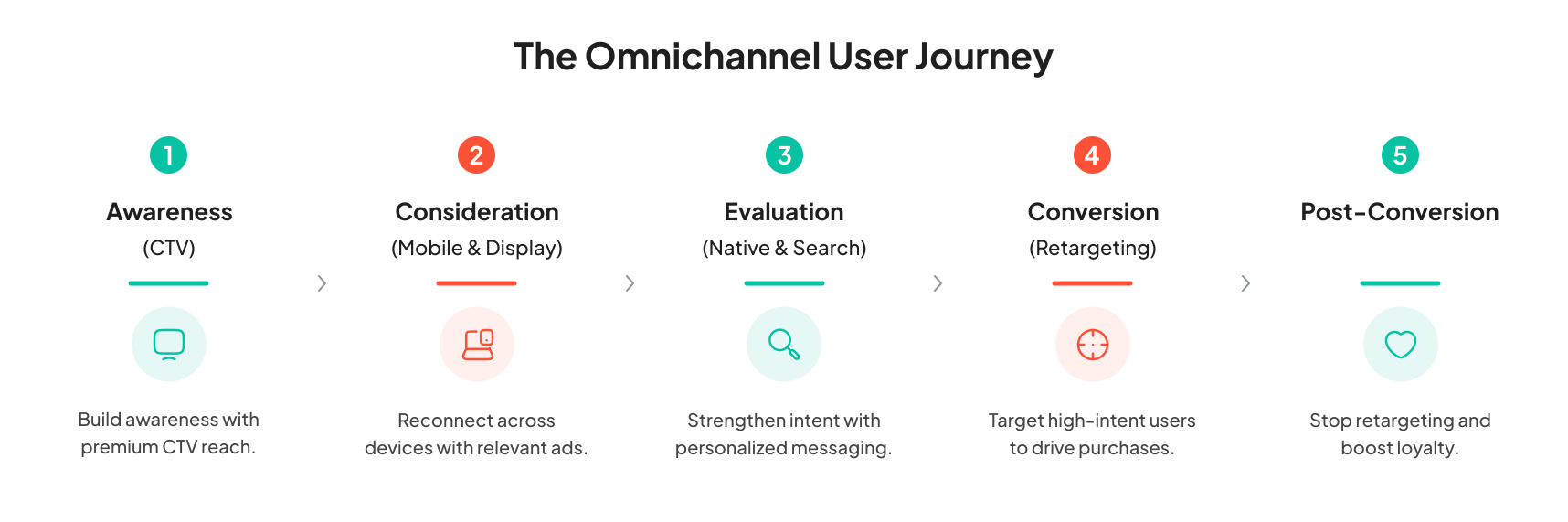
On the operational side, the omnichannel DSP platform traces the user’s journey through each stage of activation and leads customers from the first-funnel impression to the moment of conversion. Here’s what this progression looks like in practice.
Step 1: Awareness (CTV)
The audience targeting journey begins in a brand-safe, lean-back environment. In this regard, the CTV format is ideal for building campaign awareness because users are strongly engaged with long-form content on full screen. Compared to digital video formats, CTV inventory skews heavily toward non-skippable ad pods, which structurally supports brand recall and intent signaling, though skippable formats are increasingly available across major AVOD and FAST platforms such as Hulu, Peacock, and Amazon.
Once the impression is delivered, the omnichannel DSP associates it with a household identifier and opens the record of campaign exposure for that specific user profile.
Step 2: Consideration (Mobile & Display)
When users from the identified household use mobile or desktop devices, the DSP platform recognizes them within the specific user profile and starts serving consideration-phase ad creatives to them. These may be product-focused display ads, dynamic retargeting banners with particular SKUs of interest, or mid-funnel audience targeting videos.
At this stage, cross-device frequency management is crucial. The omnichannel DSP solution treats each device as connected to the household and distributes ads across them within a single touchpoint history.
Stage 3: Evaluation (Native & Search Retargeting)
As users move down the campaign funnel, the omnichannel DSP strengthens contextual and intent signals. To achieve this goal, the platform’s audience targeting engine activates native placements aligned with the user’s recently visited product pages. Dynamic creative optimization (DCO) should be employed now to adjust ad content to users’ most recent interests, geography, and proximity to physical stores, thus maximizing the purchase probability.
Stage 4: Conversion (Personalized Retargeting)
Users who have added products to cart or initiated checkout receive maximum attention from the omnichannel DSP engine. At this point, high-urgency audience targeting tools are activated across all available inventory, from mobile to desktop and in-app channels. Incentive-based and urgency-based creatives are more expensive because they target users with high conversion potential.
Stage 5: Post-Conversion
As soon as conversion happens (the user makes a target purchase), the DSP’s core task is to suppress retargeting ads immediately. Otherwise, the advertising budget gets wasted, and redundant ads result in poor UX. At the same time, the audience targeting system launches post-purchase messaging, which boosts loyalty and upsells.
How Omnichannel DSPs Resolve Identity Across Devices
Omnichannel DSP platforms can’t work effectively without accurate identity resolution. Cross-channel ads can’t be orchestrated if the system fails to understand that a person watching CTV is the same person googling shoes on a smartphone. Yet, this audience targeting component represents the greatest technical complexity in DSP design. Contemporary DSPs resolve this challenge as follows:
Household CTV Graphs. CTV identity is a critical element of household-level campaign design and audience targeting. Yet, it complicates device-level attribution. Thus, top-tier DSPs employ probabilistic modeling to associate IP addresses and device clusters to target households effectively.
ACR-Based Household Signals. Smart TV manufacturers including Samsung Ads, LG Ads, and Vizio/Inscape expose Automatic Content Recognition (ACR) data that logs viewing behavior at the household level. Leading DSPs integrate ACR signals into their identity graphs to improve CTV-to-device match rates beyond what IP-based inference alone can deliver.
Deterministic Matching. Deterministic identity resolution is built on authenticated audience signals. These include a hashed email address, phone number, or logged-in user ID. The DSP uses this data to match authenticated identifiers across all environments where they appear. This approach promises the highest accuracy, but its outreach is limited because of reliance on verified data signals only.
Probabilistic Modeling. Probabilistic campaign signals come into play where the DSP platform lacks deterministic data. Under this approach, device connections are modeled based on shared audience attributes, such as IP addresses, geographic co-location, and temporal proximity of associated activities. These models analyze data at scale by processing millions of bid requests and refining match confidence scores. The system is not ideal, but it ensures reasonable cross-device match rates that inform large-scale campaigns.
Universal IDs. As the industry navigates a fragmented and increasingly privacy-regulated identity landscape, driven by Safari and Firefox tracking prevention, iOS App Tracking Transparency (ATT), and GDPR and US state privacy law enforcement, advertisers are building resilience through alternative identity frameworks that do not depend solely on third-party cookies. Universal ID resolutions, including Unified ID 2.0 (UID2), ID5, and RampID, enable identity resolution activities without third-party cookie reliance. Omnichannel advertising is thus powered by integration of multiple UID sources, balancing targeted outreach with privacy compliance.
First-Party Data Onboarding. If advertisers have strong first-party datasets, such as CRM files or loyalty program data, they can onboard this data into the DSP platform and match hashed identifiers against the DSP’s identity graph. This method gives maximum accuracy for campaigns targeting known customers.
These strategies contribute to robust identity resolution, which advertisers can use with practical advantages: device-agnostic impression caps, sequenced messaging at different stages of user journey, and conversion attribution to the full touchpoint chain of the campaign.
Cross-Channel Attribution: Measuring the Path from Impression to Sale
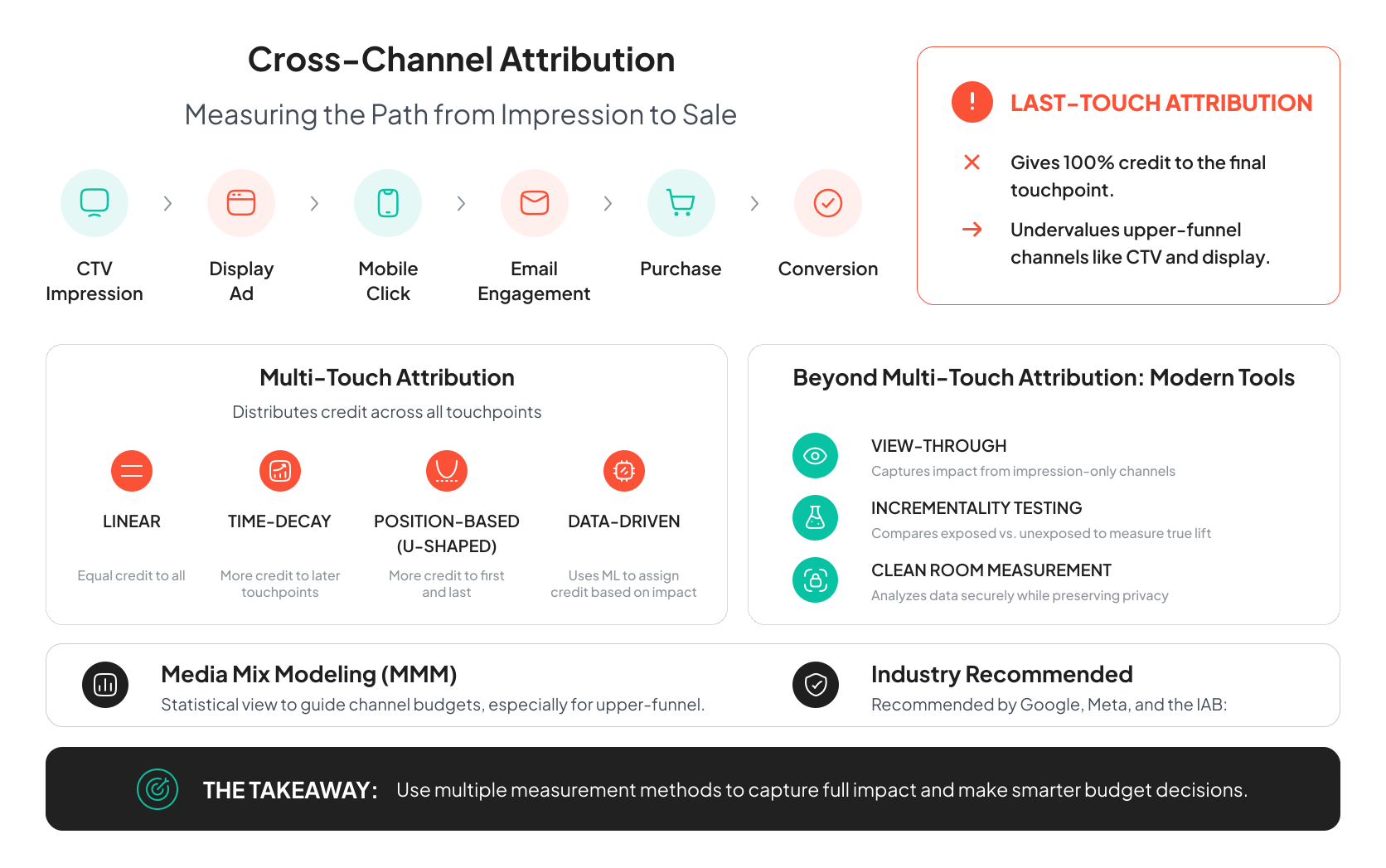
Attribution has always been challenging in digital advertising, and omnichannel environments multiply this complexity. The flaw of last-touch attribution is pronounced in multi-channel advertising campaigns because this approach assigns the entire conversion credit to the final touchpoint without considering the input of intermediary elements. Under this arrangement, upper-funnel channels like CTV and display advertising are measured as low-performing, so budget cuts affect these most important initial touchpoints of the user journey.
A more sensitive measurement approach in omnichannel advertising is multi-touch attribution. These models distribute credit across all touchpoints to illustrate the contribution of every element to the full conversion path. They include:
Linear attribution – assigning equal weight to every touchpoint involved in the campaign’s sequence.
Time-decay attribution – increasing credit weighting for later-stage touchpoints.
Position-based (U-shaped) attribution – giving more credit to the first and the last touchpoint.
Data-driven attribution – the most sensitive approach involving ML algorithms for analysis of millions of conversion paths to assign individual credit weights to touchpoints based on their historical performance.
Besides multi-touch attribution, modern omnichannel DSP platforms employ view-through attribution (suitable for impression-only channels like CTV), incrementality testing (controlled experiments to compare conversion rates across ads and assign credit weight based on the findings), and clean room measurement (isolated campaign data weighting in a secure, privacy-preserving environment). Media Mix Modeling (MMM) has also re-emerged as a standard complement to user-level attribution methods, providing channel-level budget guidance at a statistical aggregate level. MMM is particularly valuable for upper-funnel channels like CTV and display, where user-level signal is limited, and is now explicitly recommended by Google, Meta, and the IAB as part of a comprehensive measurement portfolio.
Budget Allocation and AI Optimization Across Multiple Channels
Omnichannel advertising contexts pose unique challenges for budget optimization, as the advertiser may never be completely sure about which channel at what stage of the user journey adds the greatest weight to conversion. The following strategies help advertisers manage budgets effectively:
Cross-Channel Pacing and Allocation. High-quality DSPs manage budgets as a unified source without segmenting money per channel. This way, if the system notices that one campaign channel is consistently underperforming, it can dynamically allocate funds to other channels to maximize campaign output.
AI-Driven Bid Optimization. Present-day DSP industry standard employs machine learning for bid requests’ analysis based on hundreds of signal variables. Advanced systems are trained on cross-channel exposure data to increase the probability of conversion using the whole dataset about user behavior without sticking to on-channel information.
Channel Role Modeling. Omnichannel DSPs don’t treat all channels as interchangeable conversion drivers. They distinguish between each channel’s functional roles and assign a specific place in the conversion path to them. This way, campaign budgets are distributed wisely across well-performing channels while preserving the sequence of functions (awareness, intent priming, consideration, retargeting, etc.).
Scenario Planning and Forecasting. AI-powered forecasting models help advertisers test their advertising campaigns with different budget distributions based on historical data. This functionality removes trial and error from real-money advertising activities and enables strategy fine-tuning before launching the campaign.
Supply Path Optimization (SPO). Modern DSPs apply machine learning to evaluate and rank supply paths by quality, fee transparency, and win rate efficiency. SPO reduces intermediary redundancy across omnichannel inventory sources, ensuring that budget reaches high-quality placements through the most direct and cost-efficient routes available.
Omnichannel DSP for Retail and E-Commerce: Commerce Data in the Loop
The unique advantage that omnichannel DSPs unlock for retail and e-commerce advertisers is the ability to integrate real-time commerce data into the advertising decision loop. This twist is a real market differentiator, achieved in practice with the help of:
Product-Level Dynamic Targeting. Omnichannel DSP platforms are great at serving dynamically assembled ads that match the concrete user’s browsing history, cart activity, and purchase patterns.
First-Party Retail Data-Backed Funnels. Retailers with vast first-party datasets can take advantage of DSPs by training algorithms with real historical data instead of modeled intent simulations.
Retail Media Network Integration. Brands that sell via retail partners can activate inventory through retail media networks (RMNs), closed-loop advertising environments that generate highly accurate, purchase-verified attribution data. By 2025, RMNs have matured into major programmatic channels in their own right, with platforms such as Amazon DSP, Walmart Connect, Criteo Retail Media, and Instacart Ads offering DSP-integrated access to high-intent shopper audiences. The IAB’s Retail Media Measurement Standards now provide a common framework for evaluating RMN performance alongside broader omnichannel campaigns.
Closed-Loop Measurement. By collecting commerce data and feeding it back into the DSP decision engine, brands achieve greater degrees of attribution accuracy. Retail-connected DSPs capture and process data from digital and physical channels, thus informing better campaign planning.
Striving for a genuinely omnichannel DSP experience?
Geomotiv’s team builds omnichannel DSP experiences in mind. Book a consultation with our tech team to embrace operational benefits of our solutions.
Conclusion
The promise of omnichannel advertising is appealing, but its technical execution is challenging for many DSPs. Genuine omnichannel outreach requires a combination of cutting-edge infrastructure and intelligence that has nothing in common with buying ad inventory in multiple channels. An omnichannel DSP platform should exemplify orchestration on all levels:
Unified inventory access.
Cross-device identity resolution.
Well-orchestrated messaging sequences.
Conversion attribution across the entire touchpoint chain.
AI optimization of the omnichannel ad mix.
These features transform siloed systems into a coherent and measurable customer engagement engine that can be continually improved based on real-time performance data. Proper attention to these DSP characteristics distinguishes omnichannel advertising from advertising that appears on multiple screens.
What role does artificial intelligence play in DSPs?
AI is embedded into all operational layers of modern DSPs. Machine learning models evaluate signals and generate RTB prices in milliseconds. AI also drives smart audience segmentation, DCO, budget pacing, fraud detection, and forecasting. Specifically in omnichannel advertising, AI harmonizes operations at a level that rules-based systems can’t achieve. Advanced AI models can model the nuances of interactions of exposure across multiple channels with conversion probability, which allows dynamic impression pricing.
What is an omnichannel DSP?
Omnichannel DSPs represent programmatic advertising platforms that offer the full cycle of advertising campaign management capabilities (planning, buying, optimizing, measurement) across channels. Cross-channel integration distinguishes omnichannel DSPs, enabling advertisers to plan sequenced user journeys across devices and channels.
When does an omnichannel DSP make sense?
Omnichannel DSPs offer the highest value to advertisers whose customers engage with the brand through 2+ touchpoints. This DSP type is specifically useful for retail and e-commerce brands, subscription and app-based businesses, CPG and FMCG brands, agencies and trading desks – all of which target users across multiple devices and conduct advertising at scale.
Fill out the form below and we’ll get in touch within 24 hours
Software development expertise and senior tech talent for AdTech and Streaming Media projects.
Contact Us
Fill in the form
Thank you! We'll get in touch very soon.
Also you can book a call with our senior manager
We will be glad to see in our team!
Fill in the form
Thank you! We'll get in touch very soon.
Also you can book a call with our senior manager
Get a Free Consultation
Looking to build a successful custom software solution? Our experienced development team is ready to assist.
Thank you! We'll get in touch very soon.
Also you can book a call with our senior manager
Cookie Consent
We as well as our partners use cookies to enhance your browsing experience, analyze site traffic, and personalize content. For more details, see our Cookie Policy.
FunctionalAlways active
The technical storage or access is strictly necessary for the legitimate purpose of enabling the use of a specific service explicitly requested by the subscriber or user, or for the sole purpose of carrying out the transmission of a communication over an electronic communications network.
Preferences
The technical storage or access is necessary for the legitimate purpose of storing preferences that are not requested by the subscriber or user.
Statistics
The technical storage or access that is used exclusively for statistical purposes.The technical storage or access that is used exclusively for anonymous statistical purposes. Without a subpoena, voluntary compliance on the part of your Internet Service Provider, or additional records from a third party, information stored or retrieved for this purpose alone cannot usually be used to identify you.
Marketing
The technical storage or access is required to create user profiles to send advertising, or to track the user on a website or across several websites for similar marketing purposes.