Auction Website Development Cost in 2026: Full Breakdown You Need to Know

Auction Website Development Cost in 2026
Table Of Contents:
Categories:

You are pricing auction and bidding platform development, and the estimates you find range from $50,000 to $500,000+. That is a wide gap, and most quotes don’t explain what puts a project at one end or the other.

The question is worth getting right, because demand for auction platforms keeps climbing. The online auction market is valued at $24.75 billion in 2026 and projected to reach $70.64 billion by 2035, growing at a 12.36% CAGR. eBay alone serves 135 million active buyers and hosts 2.5 billion live listings.

Competing in that market takes more than a basic bidding site. Buyers expect real-time updates, mobile access, and a platform that stays live through a busy close. Each of those requirements takes engineering hours and adds a new line of expenses to your budget.

Let’s overview what actually drives the auction website development cost, so you can scope your build and plan the budget around it.

What Factors Determine the Cost for Auction Platform Web Development?

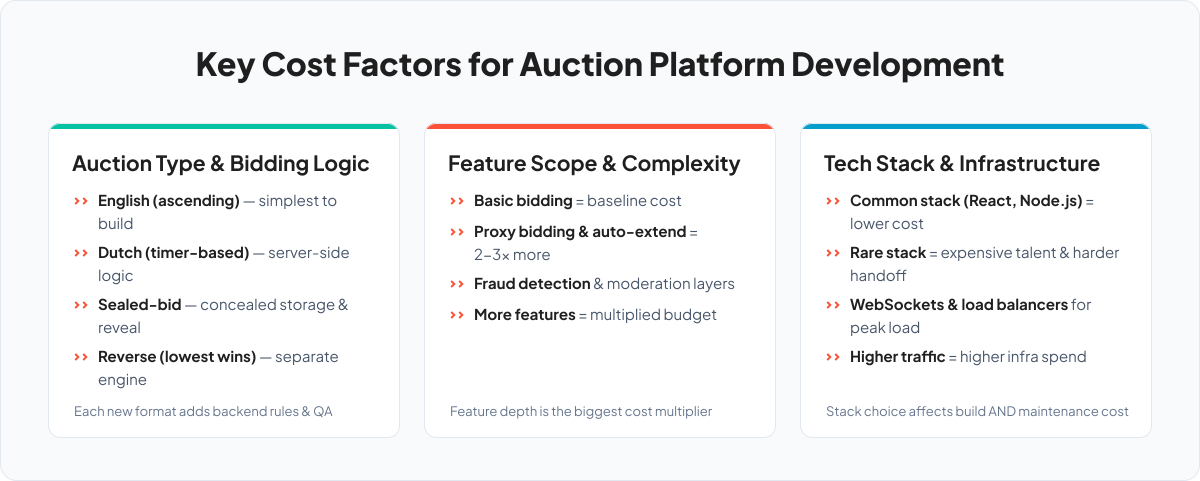
The cost of online auction development is shaped by the auction type you need to support, the depth of your feature set, and the infrastructure decisions you make during a scoping phase.

Auction Type and Bidding Logic Complexity

Your auction format determines the complexity of your backend bidding engine:

  • English auction (ascending price, highest bidder wins). Most platforms start from this auction type, because it’s the simplest to implement.
  • Dutch auction (price drops until someone buys) requires server-side logic to lower the price on a timer and close the auction the moment a bid lands.
  • Vickrey or sealed-bid auction (bids hidden until revealed) needs concealed bid storage and reveal mechanics.
  • Reverse auctions (lowest bid wins, common in procurement) run the logic backward, so the core engine can’t be reused.

Each format adds distinct backend rules, edge cases, and QA efforts. If you need to support multiple bidding types simultaneously, you must develop and test separate engines, so the cost to build an auction website increases with every new format.

Feature Sсope and Complexity

Feature scope is the next multiplier in auction app development cost estimates. What a platform includes and how far each feature goes shifts with the requirements. For example, building the basic bidding logic is one part of the budget. Adding proxy bidding, auto-extend, and fraud checks costs several times more.

Technology Stack and Infrastructure

The tech stack you choose during planning affects the cost of building and maintaining the auction platform. Here’s why.

A widely used stack lowers hiring costs. When the auction platform runs on technologies most developers know, like React or Node.js, you find the team faster, pay standard rates, and can hand the project to another team later without a rewrite. A rare stack does the opposite, leaving fewer developers to hire, higher compensation to pay, and a harder handoff if you change teams.

Peak load drives infrastructure costs. Auction platforms must cope with complex processing tasks. They update prices, validate each bid, and notify bidders under load. High traffic runs on technologies like WebSockets for live updates, load balancers to distribute requests across servers, and caching to reduce repeated database queries. The more your platform has to handle, the more you pay to build it.

Key Cost Factors for Auction Platform Development
Build Your Auction Platform with Geomotiv

We’ve been designing and developing auction platforms since 2010. Tell us what you have in mind, and we will take it from there.

How Much Does Online Auction Software Cost?

The cost to build an auction website in 2026 varies widely because the category can include very different functionality. On one end is a basic bidding dashboard with user accounts, listings, and a countdown timer. On the other is a platform with real-time bidding, mobile apps, payment integration, and an admin panel tailored for multiple departments.

That’s why most auction projects fall into one of three levels, or tiers:

  • Basic MVP
  • Mid-tier
  • Enterprise

Basic MVP Platform

A basic MVP covers core functionality to put a real product in front of users and see if the model works.

Best for: validating an auction concept before you commit to production-grade infrastructure.

What you get: web-based auction software. Bidders register and browse listings, sellers post items, buyers bid, and the platform closes the auction and records the winner. Payments go through a single gateway like Stripe.

Keep in mind: the platform runs on the web, so mobile development is a separate project. Bidding is not live either. Buyers see the current price when they refresh the page, rather than the moment a new bid lands.

Cost and timeline: $50,000+, and 8 to 12 weeks, with the cost to build an auction website depending on scope and your development team’s location.

Mid-Tier Platform

A mid-tier platform supports live auctions and provides the tools for day-to-day management.

Best for: operators running regular auctions as their core business.

What you get: live bidding over WebSockets, a cross-platform mobile app for iOS and Android, payments through more than one provider, and an admin dashboard where your team manages users and listings. Notifications reach bidders by push and email.

Keep in mind: security is part of the build, not a later add-on. Authentication, DDoS protection, and identity checks belong in the initial build, since adding them after launch inflates auction app development costs.

Cost and timeline: $100,000+, over 3 to 6 months, shaped by feature depth, integrations, and vendor rates.

Enterprise-Grade Platform

An enterprise platform is built on custom architecture that scales to high traffic and several auction formats.

Best for: established auction operators maintaining high bidding volume and traffic.

What you get: multiple auction types, native mobile apps, AI-assisted catalog search, and custom reporting features. The architecture remains stable when large numbers of people bid at the same time. Payments are processed under PCI DSS with built-in fraud detection mechanisms.

Keep in mind: the features and the infrastructure depend on each other, so the auction website development cost comes from the whole system working together, not from any single part.

Cost and timeline: From $150,000 to $500,000, over 6 to 12 months, driven by traffic volume, the number of auction formats, and compliance scope.

For a quick comparison, here is what each tier includes:

CategoryBasic MVPMid-TierEnterprise
Cost$50,000+$100,000+$150,000 - $500,000
Timeline8-12 weeks3-6 months6-12 months
User registration and profiles
Auction listings and management
Real-time bidding engineBasicFull WebSocketMulti-type, high-load
Proxy and auto-bidding
Payment gateway integrationSingleMulti-gatewayPCI-DSS, fraud detection
Mobile app (iOS/Android)Cross-platformNative + cross-platform
Admin panel and analyticsBasicFull dashboardCustom reporting
Search, filters, and categoriesBasicAdvancedAI-enhanced
Notifications (push/email/SMS)Email onlyPush + emailFull notification system
Scalability and load testingMinimalModerateProduction-grade

So far, you’ve learned the price ranges for each auction product tier. The next question is how to build it, and that choice affects the auction app development costs and timelines above. Geomotiv, for example, can deliver the same mid-tier platform in three ways: as a custom build, on top of an existing platform, or with white-label software.

Custom Build vs. Platform-Based vs. White-Label: Cost Comparison

The three delivery paths differ in cost, launch speed, and customization options. Here is how they compare on example of a mid-tier platform:

ApproachUpfront CostTime to LaunchCustomizationOngoing Cost
Geomotiv’s white-label software$15,000 one-time fee2-4 weeksFull, over timeNo recurring fees
Platform-based development~$54,000 subscription fee over 3 years3-6 monthsMediumSubscription plus per-transaction fees
Custom development$96,000+6-12 monthsFull, from day oneStandard maintenance
  • Geomotiv’s white-label software is a production-ready platform you brand and configure rather than build from scratch. You go live in weeks, own the code and bidder data, and pay no recurring fees or revenue share. Features extend as you grow, so the platform scales with the business instead of boxing it in.

Best for: businesses that need a branded launch and predictable costs without giving up ownership. Typical uses are charity fundraisers, liquidation sales, and local auction houses launching their first online platform or moving away from a third-party marketplace.

Explore Geomotiv’s White-Label Auction Platform

Book a walkthrough and see the admin panel, bidding flows, and branding options on a live setup.

  • Platform-based development uses an existing auction engine or marketplace framework as a foundation, then builds your specific bidding rules, UI, and integrations on top.

Best for: platforms that need specific integrations (a particular CRM, ERP, or payment setup) or custom auction logic that off-the-shelf products can’t cover.

  • A custom build is developed from the ground up, and you own the codebase. It fits businesses that need more than an existing engine can offer, whether that means unusual auction mechanics, security and compliance requirements, or deep integration with their own systems. Of the three delivery models, the сost for auction platform web development is the highest. In return, you get a platform that belongs to you and is not tied to any vendor.

Best for: businesses that need to own and control the entire platform.

How Your Development Team Choice Affects the Budget

Beyond the delivery approach, your staffing choice also affects the budget. The cost for auction platform web development depends on your team’s rate, coordination expenses, and ramp-up time.

In-House Team

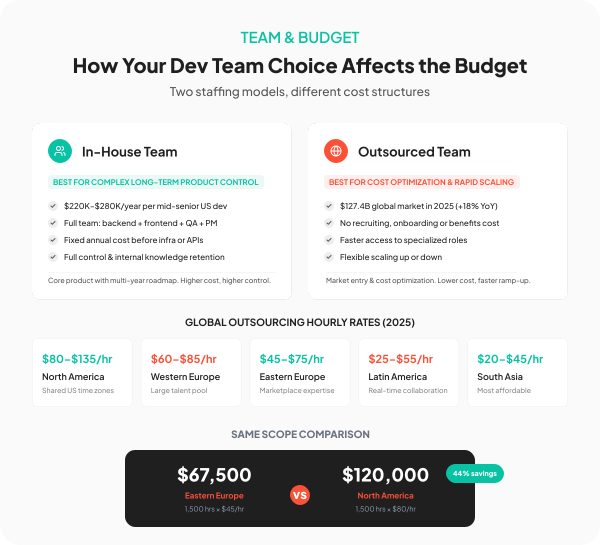
An in-house team keeps development knowledge and decisions within your company, but it comes with a price tag. A single mid-to-senior US developer costs $220,000 to $280,000 a year once you add benefits, recruiting, tooling, and onboarding to base salary. A typical team also requires at least a backend engineer, a frontend developer, a QA engineer, and a product manager. Together, that team is a fixed cost every year, before you spend on infrastructure or third-party APIs.

In-house tends to pay off when the platform is a core competitive product with a multi-year roadmap. For many startups and mid-market businesses entering the market, though, it adds cost and time-to-launch.

Outsourcing to a Dedicated Development Partner

Outsourcing to an experienced team is a popular model businesses use to optimize the cost of online auction development and access hard-to-fill roles. The global IT outsourcing market reached a record $127.4 billion in large contracts in 2025, growing 18% year over year.

Outsourced hourly rates differ by region:

  • North America: $80 to $135 per hour. Rates fall below in-house hiring, and US-based companies benefit from shared time zones.
  • Western Europe: $60 to $85 per hour. You get access to a large pool of experienced engineers, at rates below the North American range.
  • Eastern Europe: $45 to $75 per hour. Companies can staff a full auction team without long hiring rounds. Many of the region’s engineers have built bidding and marketplace platforms before.
  • Latin America: $25-55 per hour. Developer rates are low in the region, and a small time difference lets US teams collaborate in real time.
  • South Asia: $20 to $45 per hour. This is the most affordable region, but talent quality varies, so it fits well-scoped work you can oversee closely.

A dedicated development team from Eastern Europe building a mid-tier auction platform at an average of $45/hour over 1,500 hours arrives at $67,500. The same scope in North America at $80/hour reaches $120,000. That is 44% more for identical scope. However, development costs are only a part of the total budget.

How Your Dev Team Choice Affects the Budget
See a Custom Auction Build in Practice

Explore how Geomotiv designed and delivered a trade auction platform, from the bidding engine to the infrastructure behind it.

Explore the case study

Hidden and Ongoing Costs of Running an Auction Platform

The cost to build an auction website also includes ongoing expenses that determine whether the platform stays competitive over time.

Project budgets often underestimate the following:

  • Infrastructure. Cloud hosting on AWS, Azure, or Google Cloud ranges from $500 to $5,000 a month, depending on traffic, storage, and scaling configuration.
  • Payment processing fees. Stripe charges 2.9% plus $0.30 per transaction. At high volume, that adds up to operating costs, so it is worth building into your commission structure early.
  • Security and compliance maintenance. SSL certificates, penetration testing, regular security patches, and KYC/AML compliance tooling add $5,000–$25,000/year, depending on your regulatory exposure.
  • Third-party API costs. Shipping APIs, email service providers (SendGrid, Mailgun), SMS notification services, and analytics platforms carry monthly costs that scale with usage.
  • Annual maintenance. Bug fixes, compatibility updates, and minor feature additions typically add 15-20% to the original development cost per year. A $60,000 platform costs $9,000–$12,000/year to maintain.

Ongoing expenses belong in the budget from the beginning. Teams that overlook them often find the platform costs more to run than to build. Adding emerging features follows the same logic.

Emerging Features That Will Impact Your 2026 Budget

Several capabilities that were experimental 18 months ago are now expected by users on competitive auction platforms:

  • AI-powered personalization. Recommendation engines pick up on a bidder’s habits and point them to lots they would probably miss on their own. Adds $15,000 to $35,000 on a mid-tier build.
  • Live video auction streaming. Real-time video for simulcast auctions keeps bidders engaged in the moment and drives competitive bidding as a lot closes. Adds $15,000 to $40,000 and requires real-time infrastructure to function correctly during live bidding.
  • Blockchain-backed smart contracts. On-chain records and automated settlement enable buyers to verify transparency in high-value lots, which matters most for art, luxury goods, and digital assets. Adds $20,000 to $60,000.
  • BNPL integration. Flexible payment is now standard at checkout, and auctions are catching up. Buy Now, Pay Later options through Affirm or Klarna lowers the barrier on expensive items and can lift conversion. Adds $3,000 to $8,000.
  • Mobile-first architecture. M-commerce hit $2.51 trillion in 2025, and a large share of auction bidding now occurs from mobile devices. Building for mobile with Flutter or React Native costs less than separate native apps, but it still adds 30–50% to a web-only budget.

Not every platform needs all of these emerging features. The ones that make sense depend on your niche, competition, and projected effect on bidder engagement. For the features that pass that test, scope them in early. Adding them after launch will multiply costs.

How Geomotiv Plans Your Auction Platform Budget

Geomotiv has built auction and bidding platforms across real estate, medical equipment, vehicles, and B2C trade verticals. We work with different auction formats, from timed and live bidding to reverse and sealed-bid, and across platform tiers, from a first launch to high-volume enterprise operation.

An auction project with Geomotiv will start with a scoping phase. It is the stage where the build cost gets defined.

During this phase, we work through what your platform needs:

  • Your business model and the auction types you plan to run.
  • The feature set that fits your case, including which emerging features are worth building in for your niche.
  • The architecture around any system you already have, if you are moving from an existing platform.
  • The right product tier and delivery approach for your goals and budget.

Based on collected findings, we lay out the scope, which we agree on with you before development. From there, we recommend the team for the development stage, whether that is a standalone dedicated team or a few engineers to extend your own.

Get a Scoped Budget for Your Auction Platform

Tell us your auction type, feature priorities, and target launch date, and we will create a cost estimate built around your actual requirements.

Discuss your auction platform with Geomotiv

Need Help? We’ve Got You Covered!

Recommended Reading

Let Us Contact You

Fill out the form below and we’ll get in touch within 24 hours

    contact us2
    Software development expertise and senior tech talent for AdTech and Streaming Media projects.