Reliable and productive AdTech solutions ensure reaching business goals faster and more efficiently for AdTech companies, digital agencies, publishers, and brands.
Our retail media services help brands and retailers boost revenue through data-driven advertising. We specialize in programmatic ads, audience targeting, and AI-powered analytics, enabling personalized, high-impact campaigns. With expertise in retail media networks, ad monetization, and omnichannel strategies, Geomotiv maximizes customer engagement and sales.
Geomotiv partners with leading companies across streaming, media, gaming, audio, CTV, retail, and RMNs to build custom AdTech solutions aligned with their business goals.
Scale your engineering capacity with offshore software development services. Access experienced engineers to optimize costs, reduce hiring overhead, and bring custom software solutions to market faster.
From a small app to a comprehensive platform-level project, Geomotiv can develop and implement custom software solutions that involve extensive Big Data usage, storage, management, and processing.
We will help you to drive your business growth with innovative AI and ML services by automating routine processes, expanding your app features, and increasing the accuracy of business predictions.
At Geomotiv, we specialize in delivering innovative solutions that drive sustainable growth and success for your business. Let us help you transform your vision!
Get In Touch
USA (Headquarter)
700 N. Fairfax suite 614, Alexandria VA, 22314 United States
Europe
Rua Viriato 27-3A, 1050-234 Lisbon, Portugal
Western Asia
14 Paronyan St., Bln. 6, 0009 Yerevan, Armenia
Middle East
Al Marsa Street Marina Plaza, Level 27 Dubai, United Arab Emirates
Reverse auctions create price competition among suppliers competing for the same contract;
The format suits procurement, construction tenders, freight negotiations, government contracts, and healthcare staffing;
A reverse auction needs supplier qualification workflows before buyers open bidding to vendors;
A development company should have experience with reverse auction logic rather than adapting a forward auction engine for descending-price bidding.
Choosing the right reverse auction software development team depends on what you need to build, customize, and control. The project may start with an existing auction product, a custom platform, or a combination of the two.
This guide compares eight reverse auction software development companies in 2026, looking at their delivery approach, auction experience, platform capabilities, and fit for different project requirements.
What is Reverse Auction Software?
Reverse auction software manages bidding events with price moving downward rather than up. A buyer defines the requirement and invites qualified suppliers to compete. Each round drives prices lower until bidding closes and the buyer awards the contract to the winning supplier.
The model is used across industries where buyers need suppliers to compete on price for a defined product, service, project, or contract. Common use cases include:
Utilities and energy: fuel, electricity, and gas procurement contracts;
IT services: outsourcing engagements, AMC contracts, and managed service procurement.
Modern reverse auction platforms support several event formats and their hybrid combinations. They give buyers different levels of visibility and control over supplier pricing. Open descending-price auctions show competing bids in real time. Sealed-bid rounds keep supplier submissions private until the review stage. Japanese-style auctions use fixed price decrements, with the buyer setting the pace of price reduction.
Auction format
Bid visibility
Buyer controls
Open
Real-time
Competitive pricing is visible during the event
Sealed bid
Private
Offers are compared after submission
Japanese-style
Limited
Price decrements and timing
Hybrid
Configurable
Rules from multiple formats
The right format depends on the category, supplier pool, and the buyer’s negotiation strategy. For a closer look at the mechanics behind different auction models, see our guide to how an auction works. However, the format is only part of the platform. The software needs to reflect your bidding rules, supplier workflow, compliance requirements, and connections to existing systems.
What to Look for in a Reverse Auction Development Partner
If you are building a custom reverse auction platform, the software development team needs to understand those requirements before the first bid reaches the system:
Bidding logic. Reverse auction rules determine more than how the price decreases. The same logic sets up multi-round events, lot splitting, minimum decrement rules, auto-bid logic, and extended bidding. Check what the company has built before, beyond a standard forward auction engine adapted to descending pricing.
Supplier management. A reverse auction starts before suppliers submit their first bids. The platform may need to support invitations, onboarding, document validation, and qualification checks before an event opens. Look for a development team that can build these workflows into the platform rather than focusing only on the bidding interface.
Industry-specific compliance. Procurement requirements vary by industry. Construction tenders and government purchases may demand specific documentation trails and immutable bid logs. Healthcare staffing has to comply with specific regulatory requirements. A development partner with relevant vertical experience gets this right in the build phase.
Integration with existing systems. Reverse auction software often connects to sourcing workflows on one side and purchase orders and contracts on the other. The development company should have experience integrating with ERP, CRM, and procurement systems so auction data can move through the buyer’s existing workflow.
Ownership model. SaaS platforms tie the bidding logic to the vendor’s roadmap and charge per-event fees that increase with usage. Custom development puts the platform under the client’s ownership, with no recurring license fees and no reliance on the vendor’s release schedule.
The companies below differ in the depth of experience they bring to these areas.
Top 8 Reverse Auction Software Development Companies
Geomotiv.
Briskon.
Cyblance.
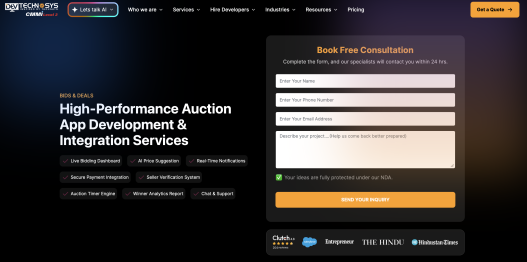
Dev Technosys.
Sapphire Software Solutions.
Fortunesoft IT Innovations.
Artesian.
OneClick IT Solution.
1. Geomotiv
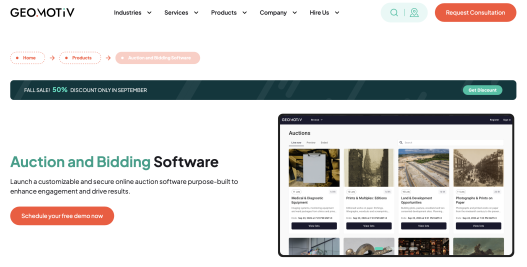
Geomotiv develops custom auction and bidding software and has worked on auction platforms since 2010. The company markets its own auction platform, which businesses can customize to their workflows and launch under their own brand. For supplier sourcing, Geomotiv offers a procurement auction platform for reverse auctions and competitive bidding.
The company adapts the platform to the client’s branding, workflows, and integration requirements. Sourcing teams across industries can launch procurement auctions on their own domain and configure the product around their use case. They can implement custom supplier qualification workflows, multi-lot management rules, sealed-bid configurations, and post-event savings analytics.
When the standard product configuration doesn’t address a specific requirement, Geomotiv can add custom functionality through its development services. The team can work on integrations, workflow changes, and additional auction capabilities while the client starts with the pre-built procurement auction platform.
Highlights:
Custom reverse and forward auction logic, configurable per event type and format.
Real-time bidding engine with 99.9% uptime SLA.
Supplier onboarding, qualification, and invitation management.
Geomotiv has delivered reverse bidding in client projects beyond procurement. Its portfolio includes an auction-driven resale platform for medical equipment and a white-label platform for healthcare staffing that uses reverse bidding to negotiate rates for open shifts.
Explore a Reverse Auction Platform Built Around Your Process
See how Geomotiv’s platform works and discuss the configuration and functionality for your sourcing needs.
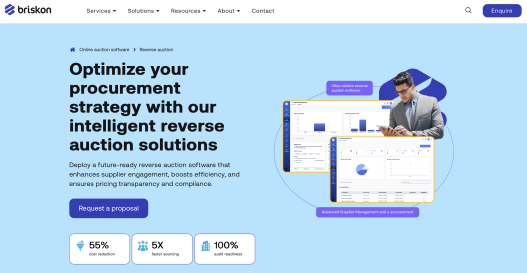
Briskon Technologies offers a reverse auction framework with pre-built bidding logic, supplier management, and ERP connectors that can be configured for different sourcing processes. Buyers can set up reverse, rank-based, Japanese-style, sealed-bid, and open descending-price events. They manage the auction process from supplier onboarding to award decisions and post-auction analysis.
For live events, auctioneers can pause bidding, extend the closing time, or set the event to close automatically. Winner detection identifies the leading supplier based on the auction rules, with a manual override when needed. Auto-bidding can place bids on a supplier’s behalf up to a preset limit, even when the supplier is offline.
Highlights:
Proprietary reverse auction framework with configurable event logic.
Sealed bid, blind bid, Japanese-style, and open descending-price auctions.
Multi-lot auctions with per-lot and split-award rules.
Supplier onboarding, rank notifications, and auto-bid engine.
SAP, Oracle, Dynamics, and Coupa ERP integration.
Multi-language interface and time-zone scheduling.
Core strengths:
Briskon’s reverse auction software can be deployed to the cloud or on-premises, with white-label options for companies that want to launch it under their own brand. Custom work can extend the product with additional workflows, modules, and integrations with existing business systems.
3. Cyblance
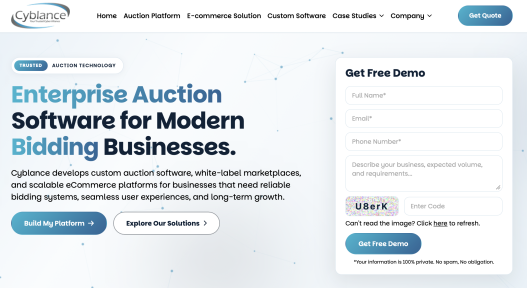
Cyblance develops custom auction software and hybrid eCommerce platforms for web and mobile. Its projects support reverse auctions as well as live, timed, sealed-bid, and silent formats. The company takes projects through planning, development, deployment, and infrastructure maintenance.
Cyblance offers white-label deployments for auction operators, agencies, and entrepreneurs. Clients can use a custom domain, branded interface, admin dashboard, and reseller-ready setup. The team has developed auction software for auto sales, heavy equipment, government surplus, and charity fundraisers.
Highlights:
Fully custom reverse and forward auction platform builds.
Web and mobile deployment options.
White-label with custom domain, branded interface, and reseller-ready setup.
Real-time bidding, supplier notifications, and payment integration.
Notifications by email, SMS, and push.
Full-cycle delivery from planning through infrastructure maintenance.
Core strengths:
Cyblance builds auction platforms around the client’s business model. Auction operators can set their own bidding rules and workflows, while agencies can brand the platform and resell it to their customers. The team develops the bidding logic as part of the custom solution, so the auction setup reflects the client’s requirements beyond a fixed product configuration.
4. Dev Technosys
Dev Technosys brings over 15 years of software development experience and a portfolio of 2,000+ delivered auction projects. The company designs bidding engine architecture, inventory management systems, payment processing modules, and analytics tools for web, iOS, and Android. Reverse auctions are one of the other auction formats in its portfolio, alongside English, Dutch, Vickrey, and sealed-bid auctions.
Highlights:
Configurable auction bidding engine with reverse auction logic.
Bidder verification, qualification workflows, and fraud detection.
Secure payment gateway integration.
Savings analytics and post-auction reporting dashboards.
Ongoing maintenance and support services.
Core strengths:
The team adapts reverse auction rules to different bidding requirements and supplier qualification criteria. Organizations can use Dev Technosys for the auction software development work without building an internal engineering team.
5. Sapphire Software Solutions
Sapphire Software Solutions develops custom auction applications for web, iOS, and Android as part of its software, blockchain, and AI development services. The company builds reverse auction functionality around the existing sourcing processes, including the bidding rules, auction formats, and interfaces that connect suppliers to the event.
For auctions that manage multiple supplier groups, Sapphire can build role-based permissions into the platform using its multi-vendor marketplace delivery experience. The bidding interface can support real-time bidding, countdown timers, notifications, user verification, and bidding history.
Highlights:
Custom reverse auction platforms for web and mobile.
Real-time bid updates and notification workflows.
Secure payment gateway and contract management integrations.
Admin dashboards for event control and reporting.
Post-deployment support.
Core strengths:
If the auction platform later needs capabilities outside bidding, the company can extend the product through its broader software development services. The same team can add related workflows, marketplace functions, or integrations as the platform scales.
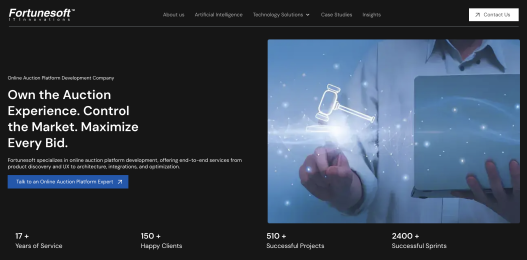
6. Fortunesoft IT Innovations
Fortunesoft IT Innovations has operated as a product engineering firm since 2009, serving clients in fintech, healthcare, and real estate. It helps companies go to market with new reverse auction platforms or update existing systems. For procurement use cases, Fortunesoft builds bidding logic around supplier competition, adapts the workflow to the buyer’s sourcing process, and incorporates industry-specific compliance requirements.
The company connects auction software to payment and escrow services, ERP, PIM, inventory, and CRM systems. These integrations link transaction, product, fulfillment, and supplier data across the systems within the procurement process.
Highlights:
Reverse and procurement auction platform delivery.
English, Dutch, multi-seller, and hybrid formats alongside reverse.
KYC, sanctions screening, and AML transaction monitoring.
Payment gateway integration and compliance reporting modules.
Custom bid analytics and audit trail tooling.
Core strengths:
Fortunesoft brings experience in regulated industries to auction projects. The company can add identity checks, sanctions screening, transaction monitoring, payment security, and privacy controls to the auction software based on the client’s domain requirements.
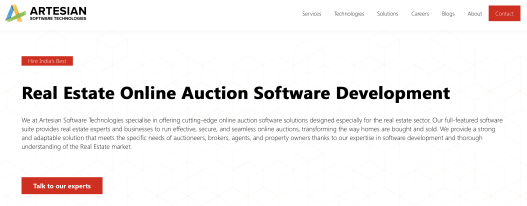
7. Artesian
Artesian Software Technologies develops auction platforms for businesses with specific bidding logic, including reverse and descending-price formats. The company also customizes AuctionWorx-based platforms to match a client’s event structure and bidding rules. It can extend an existing AuctionWorx installation when a business needs additional auction formats or functionality.
The team uses WordPress as another base for auction applications through custom plugins. It can add auction functionality to Shopify stores and existing product catalogs.
Highlights:
Custom auction software with reverse bidding configurations.
AuctionWorx customization and extensions.
Web and mobile auction applications.
Integration with payment gateways and accounting software.
Admin tools and analytics capabilities.
Core strengths:
Artesian works across custom auction development, platform customization, and integrations. Its offshore development team can take on reverse auction projects that require custom bidding logic.
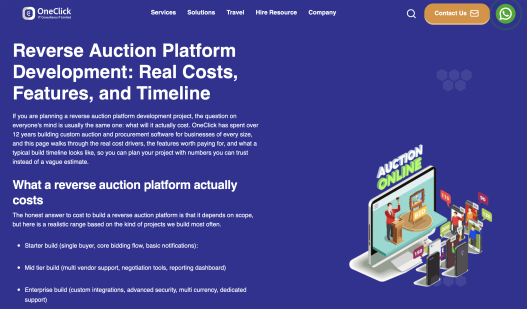
8. OneClick IT Solution
OneClick IT Solution has more than 12 years of experience with custom reverse auction and procurement software. The company builds its reverse auction solutions on a proprietary software base and configures the bidding workflow around the client’s sourcing process.
Buyers can post requirements, set supplier qualification criteria, and invite multiple vendors to compete. Suppliers can search open requirements, submit bids, and track their transactions through their own dashboards. The platform supports buyer, seller, and company registration, as well as chat, email, and SMS notifications.
Highlights:
Custom reverse auction platform builds based on proprietary software.
Supplier and vendor dashboards with qualification workflows.
Real-time bidding with mobile-ready interfaces.
Savings reporting and per-round bidding analytics.
ERP and procurement system integration.
Core strengths:
OneClick offers three levels of reverse auction development, depending on the project scope. A starter build supports a single buyer, the core bidding workflow, and basic notifications. A mid-tier solution adds multi-vendor support, negotiation tools, and reporting. Enterprise projects can include custom integrations, advanced security, multi-currency support, and dedicated support.
Quick Comparison of Top Reverse Auction Software Development Companies in 2026
The table gives a quick view of what each company brings to a reverse auction project, including its development approach, platform capabilities, integrations, and relevant areas of expertise:
Company
Best for
Key strengths
Geomotiv
Businesses that want a branded reverse auction platform they can customize
Pre-built platform, custom bidding logic, and reverse bidding use cases in healthcare staffing and medical equipment resale
Briskon
Implementation of several reverse auction formats
Proprietary framework with enterprise ERP connectors
Cyblance
Custom auction rules and workflows
Custom builds with white-label and reseller-ready deployment
Dev Technosys
Broader mobile-first auction projects that include reverse bidding
Web, iOS, and Android delivery with published timelines
Sapphire Software Solutions
Multi-supplier auctions with role-based access
Advanced role-based permission systems for auction software projects
Fortunesoft IT Innovations
Government, healthcare, and regulated industries
Focus on compliance tools
Artesian
Existing AuctionWorx installations
Platform customization and extension
OneClick IT Solution
Reverse auctions with vendor self-service
Proprietary auction platform base
Conclusion
The best starting point for choosing a reverse auction development company depends on what you already have and what the auction requires:
A configurable framework may make sense when the bidding model fits an existing product;
Custom development is better suited to projects that require specific auction rules or sourcing workflows;
Platform customization can be useful when the business already has an AuctionWorx, WordPress, or Shopify environment it wants to retain.
Before choosing a partner, review its reverse auction experience and previous projects against your requirements. Ask how the team approaches bidding logic, supplier qualification, compliance, integrations, deployment, and software ownership. These details will tell you more about the fit than a general list of auction features.
Launch a Reverse Auction Platform You Own.
Get reverse auction software you can brand, configure, and extend around your sourcing process. Keep ownership of the code, domain, and bid records, without per-event fees.
What is reverse auction software and how does it differ from a standard auction platform?
Reverse auction software lets buyers get competing prices from suppliers for a defined requirement. Standard auction software typically raises the price as buyers compete for a lot, while a reverse auction moves supplier prices downward as they compete to win the contract. Both models use similar bidding infrastructure, but forward auctions aim to increase the seller’s revenue while reverse auctions focus on reducing the buyer’s procurement cost.
Which industries use reverse auction software beyond procurement?
Reverse auction platforms suit industries where multiple qualified suppliers compete on price for the same contract or service. Construction companies use it for tenders, logistics companies for freight rates, government bodies for public contracts, and healthcare organizations for staffing rates. Each use case may require different compliance rules, supplier qualifications, and auction formats.
What features should a custom reverse auction platform include?
A custom reverse auction platform should support configurable descending-price bidding, supplier onboarding and qualification, multi-lot events, open and sealed bids, minimum decrement and reserve price rules, and savings reporting. Enterprise deployments may require ERP integration, role-based access control, and compliance documentation exports. The right configuration depends on the buyer’s event structure, procurement category, and regulatory requirements.
Can reverse auction software integrate with our existing procurement systems?
Yes. Geomotiv’s reverse auction platforms can connect to existing business systems through custom integrations. The right integration approach depends on where supplier, product, contract, and auction data resides and which parts of the procurement workflow the platform needs to support.
Fill out the form below and we’ll get in touch within 24 hours
Software development expertise and senior tech talent for AdTech and Streaming Media projects.
Contact Us
Fill in the form
Thank you! We'll get in touch very soon.
Also you can book a call with our senior manager
We will be glad to see in our team!
Fill in the form
Thank you! We'll get in touch very soon.
Also you can book a call with our senior manager
Get a Free Consultation
Looking to build a successful custom software solution? Our experienced development team is ready to assist.
Thank you! We'll get in touch very soon.
Also you can book a call with our senior manager
Cookie Consent
We as well as our partners use cookies to enhance your browsing experience, analyze site traffic, and personalize content. For more details, see our Cookie Policy.
FunctionalAlways active
The technical storage or access is strictly necessary for the legitimate purpose of enabling the use of a specific service explicitly requested by the subscriber or user, or for the sole purpose of carrying out the transmission of a communication over an electronic communications network.
Preferences
The technical storage or access is necessary for the legitimate purpose of storing preferences that are not requested by the subscriber or user.
Statistics
The technical storage or access that is used exclusively for statistical purposes.The technical storage or access that is used exclusively for anonymous statistical purposes. Without a subpoena, voluntary compliance on the part of your Internet Service Provider, or additional records from a third party, information stored or retrieved for this purpose alone cannot usually be used to identify you.
Marketing
The technical storage or access is required to create user profiles to send advertising, or to track the user on a website or across several websites for similar marketing purposes.