Reliable and productive AdTech solutions ensure reaching business goals faster and more efficiently for AdTech companies, digital agencies, publishers, and brands.
Our retail media services help brands and retailers boost revenue through data-driven advertising. We specialize in programmatic ads, audience targeting, and AI-powered analytics, enabling personalized, high-impact campaigns. With expertise in retail media networks, ad monetization, and omnichannel strategies, Geomotiv maximizes customer engagement and sales.
Geomotiv partners with leading companies across streaming, media, gaming, audio, CTV, retail, and RMNs to build custom AdTech solutions aligned with their business goals.
Scale your engineering capacity with offshore software development services. Access experienced engineers to optimize costs, reduce hiring overhead, and bring custom software solutions to market faster.
From a small app to a comprehensive platform-level project, Geomotiv can develop and implement custom software solutions that involve extensive Big Data usage, storage, management, and processing.
We will help you to drive your business growth with innovative AI and ML services by automating routine processes, expanding your app features, and increasing the accuracy of business predictions.
At Geomotiv, we specialize in delivering innovative solutions that drive sustainable growth and success for your business. Let us help you transform your vision!
Get In Touch
USA (Headquarter)
700 N. Fairfax suite 614, Alexandria VA, 22314 United States
Europe
Rua Viriato 27-3A, 1050-234 Lisbon, Portugal
Western Asia
14 Paronyan St., Bln. 6, 0009 Yerevan, Armenia
Middle East
Al Marsa Street Marina Plaza, Level 27 Dubai, United Arab Emirates
HomeBlogIndustriesTypes of Auction Models: How to Choose the Right One for Your Business
Published: Oct 20, 2026
Types of Auction Models: How to Choose the Right One for Your Business
The auction format you choose affects bidder behavior, final clearing price, and hidden costs.
English auctions encourage competition; Dutch auctions speed up time-sensitive sales.
The winner’s curse and buyer’s premiums can raise the total cost of a winning bid.
Reverse auctions can reduce procurement costs, but buyers need to set evaluation criteria to avoid sacrificing quality for a lower bid.
Standard auction software suits common workflows. Custom development fits specialized bidding rules, integrations, or data needs.
Businesses use different auction models to sell goods, source products, and manage bidding. Each model sets its own rules for how buyers place bids, compete, and win. This guide compares the main auction types, categories, and formats, explains where businesses use them, and outlines the software requirements and costs to consider. Use this information to choose the right auction and bidding software for your business.
How Auctions Actually Work
An auction works by inviting buyers or suppliers to compete through bids. The seller or buyer sets the terms, participants submit offers, and the auction format establishes how the winner is selected and what they pay or receive. For instance, some auctions let participants see and respond to competing offers, while others accept confidential bids until the event closes.
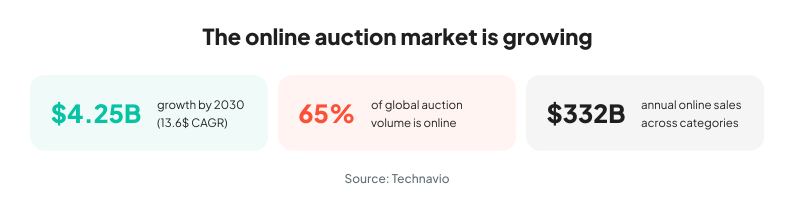
Most auction activity now takes place online. Technavio research forecasts the global online auction market to grow by $4.25 billion at a 13.6% CAGR from 2025 to 2030. Online auctions account for 65% of worldwide auction volume, representing $332 billion in annual sales across categories ranging from fine art to programmatic ad inventory.
Depending on your business goals, you can choose an auction format that sets the bidding rules. If the format doesn’t fit your goals, buyers may lose interest, sellers may get lower offers, or procurement teams may pay more than necessary.
Core Auction Types at a Glance
Format
How the Price is Set
Bid Visibility
Best for
English (Open Ascending)
Buyers compete by raising their bids
Open
Physical goods, art, real estate
Dutch (Descending)
The price drops until a buyer accepts it
Open
Perishables, treasury bonds
First-Price Sealed-Bid
The highest bidder pays their own bid
Confidential
Government contracts, land sales
Second-Price Sealed-Bid
The highest bidder pays the second-highest bid
Confidential
Ad impressions, online goods
Reverse
Suppliers compete by lowering their offers
Varies by auction
Procurement, sourcing
Launch Auctions with the Bidding Logic You Need.
Start with Geomotiv’s pre-built auction platform and adapt the bidding rules to your business. Run English, Dutch, reverse, or other auction formats without third-party fees.
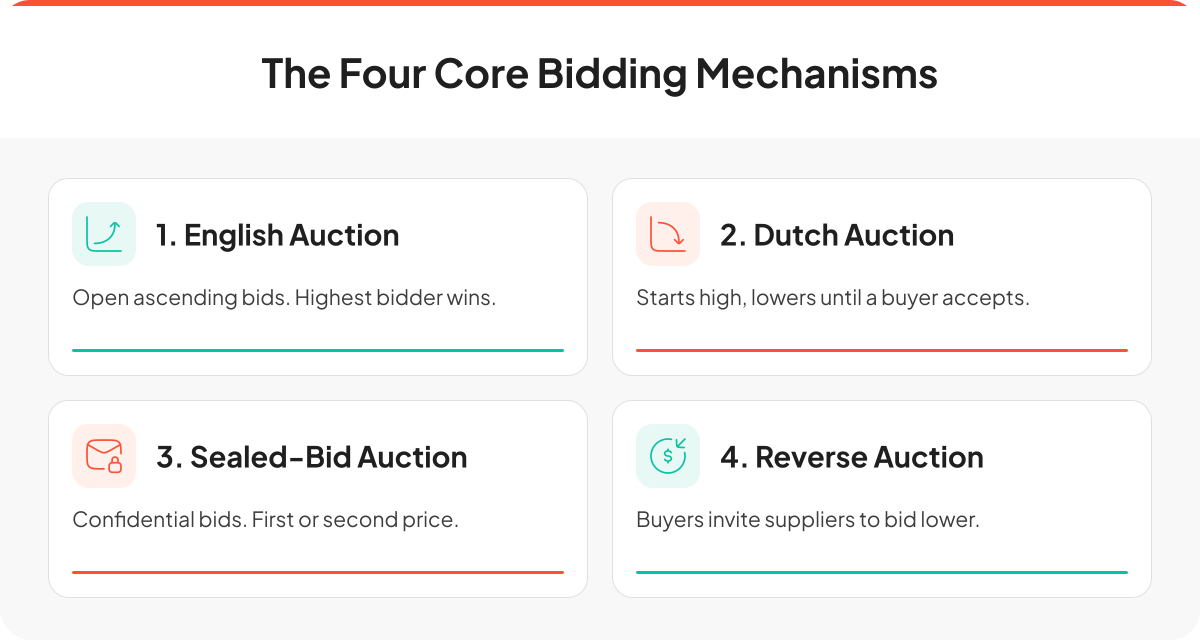
The Four Core Bidding Mechanisms
Understanding how these four auction types work helps businesses choose an approach that fits their sales or procurement goals.
English Auction
An English auction uses an open ascending-bid format where the auctioneer starts at a low price and bidders openly raise their offers as they compete. The highest bidder wins when no one is willing to bid more.
This format works best when the seller wants to encourage competition among interested buyers. Art auctions, real estate, and livestock markets rely on it because visible competition encourages participants to reveal how much they value the item. However, bidders may leave when the price exceeds their budget.
Dutch Auction
A Dutch auction starts at a high price and lowers it until a buyer accepts. The first buyer to accept the current price wins and pays that amount.
This format works well for time-sensitive items, especially when unsold inventory loses value. Flower markets in the Netherlands pioneered it for that reason. Some government bond offerings also use Dutch auction methods, though their rules differ from the traditional descending-price format. Agricultural sellers can use agriculture auction software to run online sales for perishable crops and other inventory where delays can add costs.
Sealed-Bid Auction: First-Price vs. Second-Price
In a sealed-bid auction, bidders submit a confidential offer without seeing competing bids. The auction can use first-price or second-price rules to calculate the final amount. The winner pays either their own or the second-highest bid.
Dimension
First-Price
Second-Price (Vickrey)
Winner pays
Their own bid
Second-highest bid
Optimal strategy
Bid below estimated value
Bid true value
Seller revenue
Varies with shading
Theoretically equivalent
Buyer risk
Overpayment
Winner's curse risk lower
Programmatic use
Dominant post-2019
Common in earlier auction models
Most ad exchanges and supply-side platforms shifted from second-price to first-price auctions starting in 2019. Demand-side platforms had to adjust their bidding strategies because the winning bid now determined the payment rather than the second-highest offer.
Reverse Auction
In a reverse auction, a buyer invites suppliers to compete for a contract by lowering their offers. The buyer typically awards it to the lowest qualified bidder or evaluates quotes against additional criteria.
Reverse auctions can help procurement teams negotiate lower prices when suppliers compete for comparable work. However, a low bid doesn’t guarantee the best overall deal. Suppliers may cut costs in ways that affect quality or service if the buyer’s requirements are unclear. Buyers should define the scope, specifications, and evaluation criteria before bidding begins so suppliers compete on comparable terms. Construction bidding platforms are one of the more common places this mechanism shows up outside procurement.
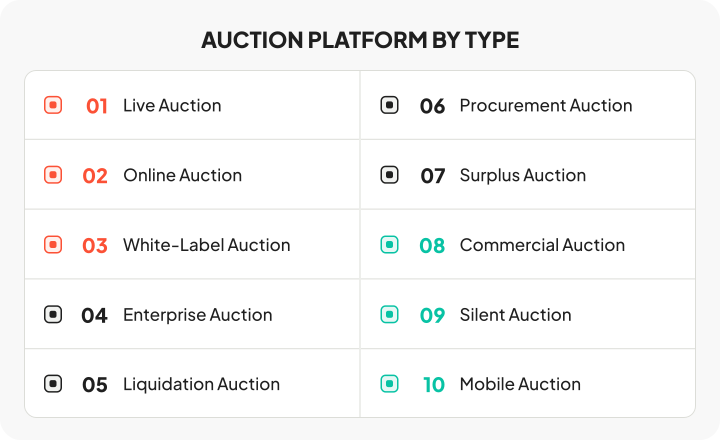
Auction Platforms by Type
The platform type determines how participants access an auction and how the operator manages bidding. A live event, a mobile auction, and an enterprise procurement system have different operational requirements, even if they use the same bidding mechanism. A custom auction and bidding platform should also match those requirements before designing bidding logic.
Live Auction
A live auction takes place in real time. A human auctioneer manages the process in front of an in-person audience, announces offers, responds to the pace of bidding, and closes the sale when no participant is willing to bid more.
Strengths: Emotional engagement and visible competition encourage higher offers
Limitations: In-person events limit participation to people who can attend. Online or hybrid bidding can extend the reach beyond the venue.
Online Auction
Online auctions let participants bid through a website or dedicated platform without attending an offline event. The software validates bids, tracks deadlines, records activity, and notifies participants about relevant updates and results. Market Research Future projects the online auction industry to grow from $739.12 billion in 2025 to $1,658.89 billion by 2035, at a CAGR of 8.42%.
Benefits of online auction platforms:
Mobile bidding and real-time alerts to keep buyers engaged through auction close.
Personalized lot discovery to help bidders find relevant items in large catalogs.
Access to buyers beyond local markets to attract more participants.
White-Label Auction
A white-label auction platform provides licensed infrastructure that a company brands as its own. A vendor provides the underlying bidding engine, payment processing, and lot management. The operator configures the buyer experience around its products, processes, and business requirements.
Depending on the vendor, the agreement may add recurring license or transaction fees and limit access to the source code and ownership of auction data.
Enterprise auction systems fit organizations with complex operations, high-value transactions, or events across multiple business units and territories. They may include advanced lot management, audit records, access controls, and integrations with ERP, inventory, finance, and procurement systems.
Key requirement: Integration with existing business systems. If the platform can’t exchange data with Enterprise tools, teams may need to reconcile records manually, adding work instead of reducing it.
Liquidation Auction
This auction platform helps businesses sell surplus, returned, or distressed assets below market price to recover partial value quickly. Retail returns, manufacturing overstock, and estate assets move through liquidation channels this way.
Primary goal: Sell items quickly at an acceptable clearance rate. Lot grouping, accurate condition descriptions, and access to relevant buyers help sellers move stock without requiring individual sales for every item.
Procurement Auction
Procurement auctions use reverse bidding logic to source goods and services competitively. The buyer defines specifications, and qualified suppliers bid downward over a defined window. After bidding closes, the buyer evaluates suppliers against criteria such as price, service terms, and quality.
The platform provides:
Supplier price competition through downward bidding among qualified suppliers.
Faster bid comparison with competing offers collected in one place.
Clearer compliance records through bid tracking and a complete audit trail.
Surplus Auction
Surplus auctions help organizations sell assets they no longer need, such as government fleet vehicles, decommissioned equipment, and excess inventory.
Features to look for:
Lot organization by asset type, condition, and location.
Bulk listing for multiple surplus items.
Asset catalogs with photos, condition reports, and delivery options.
Commercial Auction
Commercial auctions facilitate the sale of business assets such as machinery, electronics, real estate, and equipment. Sellers may need to prepare valuation reports, ownership documents, and asset condition records. Specialized used machinery auctions may also need inspection details to help buyers assess what they are bidding on.
How software manages documentation: The platform needs to centralize asset records so buyers can review relevant information before bidding.
Silent Auction
A silent auction lets participants submit bids privately, often by writing offers on bid sheets or entering them through an online system. The highest eligible bid at closing wins the item. Common in nonprofit fundraising, silent auctions let organizers raise money through confidential donations.
Key characteristic: Participants don’t respond to visible, ascending bids in real time. Organizers set a closing time, and the highest eligible offer at that point wins.
Mobile Auction
Mobile auction platforms are designed for participants who bid on smartphones or tablets. They adapt lot listings and bidding controls to smaller screens and can send push notifications when a participant is outbid or an auction is about to close.
Specific features: Responsive bidding controls, high-resolution lot photos, outbid alerts, and closing-time notifications. In automotive auctions, these features help buyers review vehicles and place bids without being tied to a desktop.
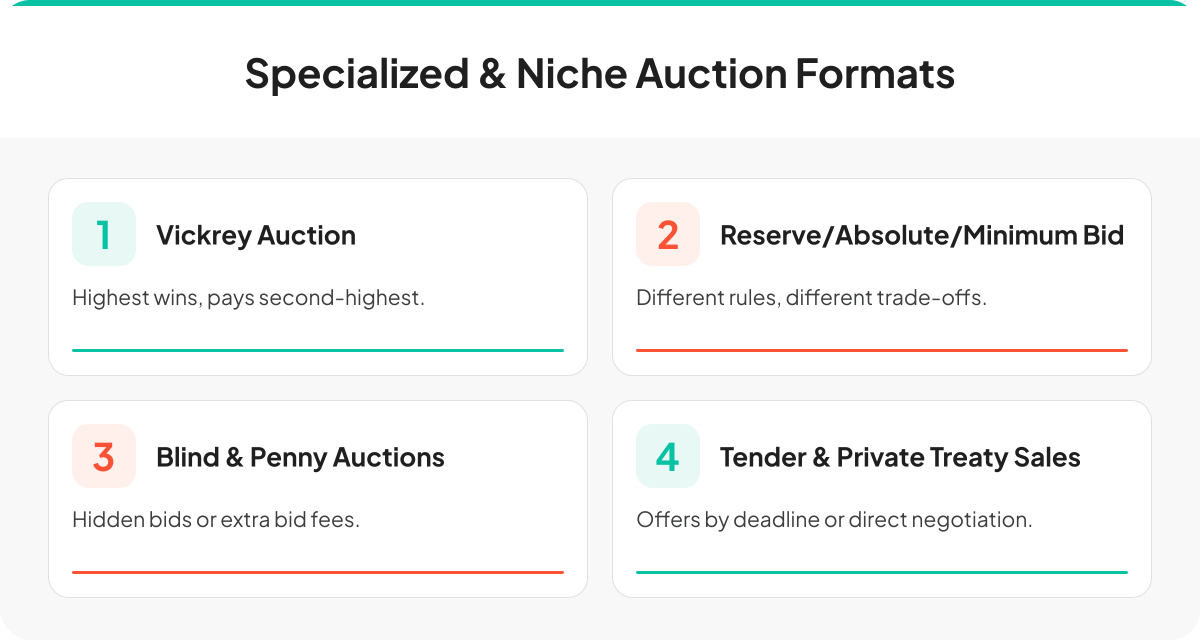
Specialized and Niche Auction Formats
Several specialized formats fall outside the mechanisms and platform categories above. Some rely on specialized pricing rules or sale conditions for specific markets. Others, such as private treaty sales, offer an alternative to live bidding.
Vickrey (Second-Price Sealed-Bid) Auction
In a Vickrey auction, buyers submit a single sealed-bid offer. The highest bidder wins but pays only the second-highest price. This payment rule encourages participants to state their true willingness to pay, a dominant strategy in a standard second-price auction.
Digital advertising uses a related mechanism called the Generalized Second-Price (GSP) auction. Google adopted GSP for its AdWords Select advertising system in 2002, but GSP differs from a standard Vickrey auction. It allocates multiple ad positions at once and doesn’t generally make truthful bidding a dominant strategy.
Reserve, Absolute, and Minimum Bid Auctions
A reserve auction sets a minimum acceptable price, often kept confidential. If bidding doesn’t reach the reserve, the seller can withhold the item. An absolute auction has no reserve, so the highest bidder wins regardless of the final price. A minimum bid auction publishes the starting price floor openly.
Each approach comes with a different trade-off. A reserve protects the seller from accepting a low offer, while an absolute auction gives buyers certainty that the highest bidder will win. A published minimum bid helps buyers judge whether the item fits their budget before participating.
Blind and Penny Auctions
In a blind auction, bidders submit offers without seeing competing bids, similar to sealed-bid but often used in real estate or M&A processes. Real estate deals structured this way sometimes run through dedicated real estate auction software to keep the bid trail auditable.
A penny auction uses a different model. Participants pay a fee for each bid they place, in addition to the winning price. This format can generate additional revenue from bid fees, but operators must make those charges clear to bidders.
Tender and Private Treaty Sales
A tender invites interested parties to submit offers by a set deadline, then evaluates them on price and terms. Unlike a typical live auction, bidders may not see or respond to competing offers during the process.
When a buyer and seller need to negotiate directly, an auction platform can also support private treaty sales. The parties can discuss the price, payment terms, and other conditions until they reach an agreement. This approach suits specialized or high-value assets when the seller wants to assess the buyer’s overall offer, including terms that go beyond price.
The Hidden Costs of Winning
Winning an auction feels good, but two costs can make that win less attractive: the winner’s curse and the buyer’s premium. The first occurs when a bidder overestimates an item’s value, while the second adds a fee to the winning bid. For platform owners, helping participants understand these costs can build trust and encourage them to return.
Winner’s Curse
The winner’s curse occurs when the winning bidder pays more than the item is worth. When participants have incomplete information, the highest offer may come from the person whose estimate was furthest above the actual value.
This risk affects programmatic advertising specifically. As the industry shifted toward first-price auctions, buyers had to pay their own winning offers rather than the second-highest price. Research on this transition reports that traffic prices increased by 59%. DSPs responded with bid shading, which lowers each bid toward the expected clearing price, alongside other programmatic advertising strategies.
Businesses can reduce the winner’s curse risk by estimating value before bidding starts. Procurement teams, for example, can rely on clear specifications and realistic cost targets before suppliers compete.
Buyer’s Premium
A buyer’s premium is a fee added to the winning bid, usually calculated as a percentage of the hammer price. Major auction houses can charge premiums of up to 30%, with Christie’s setting their lowest tier at 28% in 2026. As a result, a buyer who wins an item at $100,000 and pays a 28% buyer’s premium owes $128,000 before any other applicable charges.
If your auction model includes a buyer’s premium, disclose the fee before bidding begins. Clear pricing helps participants calculate their total costs and avoids surprises that could discourage them from returning.
Choosing and Building the Right Auction Format
Choose an auction format based on your business goals, the items you sell or source, and how you plan the bidders to participate.
A Decision Framework
Use these criteria to narrow your options:
Asset type. Unique items such as art or real estate often require English auctions. Dutch auctions work well for time-sensitive inventory. Reverse auctions suit procurement, where suppliers compete to win a contract.
Revenue or speed. Open ascending auctions encourage buyers to outbid one another, potentially raising the final sale price. Dutch auctions can speed up time-sensitive sales, while sealed bids let sellers compare offers submitted by a set deadline.
Participant pool. Open bidding fits when you want multiple buyers to compete publicly. Sealed bids and tenders suit curated groups of buyers or suppliers whose offers need confidential evaluation.
Award criteria. If price alone determines the winner, the highest bid or lowest qualified offer may be enough. Procurement auctions may need to account for quality, delivery schedules, service levels, and price. Choose a format and evaluation rules that match how you plan to award the deal.
Regulatory context. Government procurement and other regulated transactions may require specific bidding procedures, transparent evaluation criteria, and auditable records.
Volume and frequency. High-frequency transactions often need automated bid processing and reporting. Less frequent, high-value auctions may also require expert review and manual approval steps.
Off-the-Shelf vs. Custom Development
The buy vs. build decision for auction software depends on how closely standard products match your business rules. Off-the-shelf platforms can suit common auction workflows and go live in weeks. However, the vendor’s bidding logic, data model, and integration options may limit changes when your requirements differ from the standard setup.
Dimension
Off-the-Shelf
Custom Build
Time to deployment
Weeks, depending on configuration
Months, depending on scope
Upfront cost
Low (SaaS licensing)
High ($500K-$2M+)
Ongoing cost
License + transaction fees
Infrastructure, maintenance, engineering
Bidding logic ownership
Differs by vendor
Your team
Integration flexibility
Depends on available APIs and vendor support
Unlimited
Differentiation potential
Limited by available features and customization
Unlimited
Custom development makes sense when auction rules give your business a meaningful competitive advantage. For example, proprietary bidding, pricing, or eligibility logic may affect revenue enough to justify owning and maintaining the system. Geomotiv’s dedicated development teams have built auction infrastructure for clients with these needs. One example is a white-label medical auction platform for healthcare staffing built around specialized bidding workflows.
No single revenue figure determines when custom development makes financial sense. The decision depends on transaction volume, licensing and transaction fees, integration needs, maintenance costs, and the business value of controlling the auction logic. Compare the total cost of ownership over several years before committing to either approach.
Geomotiv’s auction and bidding platform offers another option:
It lets you start with existing auction software, customize bidding rules, and combine auction formats to fit your business needs, without building the entire system from scratch.
You own the source code, retain your bid records, and control the platform and auction data.
A one-time fee starts at $15,000, with no recurring license fees, helping you reduce upfront development time and avoid ongoing licensing costs.
Conclusion
English, Dutch, sealed-bid, and reverse auctions use different rules to determine how participants compete and who wins. The bidding mechanism, platform type, and sale conditions work together to determine how businesses run auctions and influence the user experience, revenue, and control over transactions.
When investing in auction software, check whether the platform supports your required bidding rules, participant access, and sales workflows. You should also be able to adapt these elements as your business needs change.
Get Auction Software Built Around Your Needs.
Geomotiv adapts its white-label auction and bidding platform to your business requirements and develops custom functionality to support specialized workflows and bidding rules.
What is the most common type of auction used today?
English open ascending-bid auctions are most common for physical goods, art, and real estate, while first-price sealed-bid auctions dominate programmatic advertising. In an English auction, buyers openly raise their bids to compete over unique items. In programmatic advertising, buyers submit bids for ad impressions in real time, and the winner pays their own bid.
How do different types of auctions affect the final price?
Some auction formats encourage buyers to bid more, while others reward those who accept a price early. In English auctions, buyers raise their bids against competing offers, which can push the price up. In Dutch auctions, the price drops until a buyer accepts it, and the winner pays that amount.
When to use a reserve price vs. an absolute auction?
Use a reserve price when you have a minimum amount you’d like to receive for an item. An absolute auction has no minimum price, so the highest bidder wins regardless of the final amount. Removing the reserve can attract more bidders, but the seller must be prepared to accept the winning bid.
What is a buyer's premium and is it negotiable?
A buyer’s premium is a fee added to the winning bid, usually calculated as a percentage of the hammer price. Auction houses and platforms set their own rates. Some may negotiate fees for high-volume or institutional buyers, but individual buyers usually pay the published rate.
How do programmatic advertising auctions differ from traditional auction formats?
Programmatic auctions sell individual ad impressions, often billions of times a day across advertising platforms. Traditional auctions typically sell specific assets, lots, or contracts through scheduled events or defined bidding periods.
Fill out the form below and we’ll get in touch within 24 hours
Software development expertise and senior tech talent for AdTech and Streaming Media projects.
Contact Us
Fill in the form
Thank you! We'll get in touch very soon.
Also you can book a call with our senior manager
We will be glad to see in our team!
Fill in the form
Thank you! We'll get in touch very soon.
Also you can book a call with our senior manager
Get a Free Consultation
Looking to build a successful custom software solution? Our experienced development team is ready to assist.
Thank you! We'll get in touch very soon.
Also you can book a call with our senior manager
Cookie Consent
We as well as our partners use cookies to enhance your browsing experience, analyze site traffic, and personalize content. For more details, see our Cookie Policy.
FunctionalAlways active
The technical storage or access is strictly necessary for the legitimate purpose of enabling the use of a specific service explicitly requested by the subscriber or user, or for the sole purpose of carrying out the transmission of a communication over an electronic communications network.
Preferences
The technical storage or access is necessary for the legitimate purpose of storing preferences that are not requested by the subscriber or user.
Statistics
The technical storage or access that is used exclusively for statistical purposes.The technical storage or access that is used exclusively for anonymous statistical purposes. Without a subpoena, voluntary compliance on the part of your Internet Service Provider, or additional records from a third party, information stored or retrieved for this purpose alone cannot usually be used to identify you.
Marketing
The technical storage or access is required to create user profiles to send advertising, or to track the user on a website or across several websites for similar marketing purposes.