Reliable and productive AdTech solutions ensure reaching business goals faster and more efficiently for AdTech companies, digital agencies, publishers, and brands.
Our retail media services help brands and retailers boost revenue through data-driven advertising. We specialize in programmatic ads, audience targeting, and AI-powered analytics, enabling personalized, high-impact campaigns. With expertise in retail media networks, ad monetization, and omnichannel strategies, Geomotiv maximizes customer engagement and sales.
Geomotiv partners with leading companies across streaming, media, gaming, audio, CTV, retail, and RMNs to build custom AdTech solutions aligned with their business goals.
Scale your engineering capacity with offshore software development services. Access experienced engineers to optimize costs, reduce hiring overhead, and bring custom software solutions to market faster.
From a small app to a comprehensive platform-level project, Geomotiv can develop and implement custom software solutions that involve extensive Big Data usage, storage, management, and processing.
We will help you to drive your business growth with innovative AI and ML services by automating routine processes, expanding your app features, and increasing the accuracy of business predictions.
At Geomotiv, we specialize in delivering innovative solutions that drive sustainable growth and success for your business. Let us help you transform your vision!
Get In Touch
USA (Headquarter)
700 N. Fairfax suite 614, Alexandria VA, 22314 United States
Europe
Rua Viriato 27-3A, 1050-234 Lisbon, Portugal
Western Asia
14 Paronyan St., Bln. 6, 0009 Yerevan, Armenia
Middle East
Al Marsa Street Marina Plaza, Level 27 Dubai, United Arab Emirates
HomeBlogAdtechAdTech Landscape: How is the Industry Developing?
We are living in the era of digitalization. The world around us is quickly changing. And it doesn’t look like it used to even a few decades ago. We detect rather profound transformations if we start considering different domains and markets.
The history of advertising in this or that form began many centuries ago. However, AdTech is a comparatively new branch. The first-ever form of programmatic advertising, such as a banner ad, appeared only in the 1990s. Though not much time has passed since then, the AdTech landscape has changed a lot.
Advertising technology has gone much beyond simple online ads. AdTech companies play a crucial role in the digital advertising ecosystem by offering sophisticated solutions for advertisers and publishers. Modern tools help enable, optimize, and automate digital advertising buying, selling, and delivery. Advertising technology is greatly shaping the marketing world in general. That’s why it is so crucial for businesses not to miss everything happening in the ad tech ecosystem these days.
In this article, we talk about the current state of this industry and the best AdTech companies that make the most significant contribution to its growth and development.
Ad Tech Landscape: What’s Going on Today?
The global AdTech market size was valued at $613.4 billion in 2025, according to IMARC Group. The market is projected to reach $1,268.6 billion by 2034, growing at a CAGR of 8.16% over 2026-2034.
As for the share of different regional markets, North America is a leader here. The North American AdTech market held over 35.6% of the global market in 2025, with the United States alone accounting for close to 77% of that regional share. The further adoption of e-commerce and retail media, integration of advanced technologies, and new advertising formats are among the strongest boosters of the growth of the global AdTech industry.
Adtech Landscape: Key Trends Shaping the Industry
The Ad Tech market is rather dynamic. Adtech companies in the USA and worldwide quickly react to new tech and business tendencies, which explains all the changes that occur today.
Let’s consider the most essential AdTech trends that can be identified now.
Shift towards first-party data. The increasing concerns around data privacy and security are pushing governments to implement more serious privacy regulations, like GDPR and CCPA. Moreover, over recent years, there have been a lot of talks about the deprecation of third-party cookies. Even though these cookies are still here to stay, top ad tech companies focus more on first-party data. Namely, the information that can be collected directly from users will likely start playing the most important role for advertisers. Today, this data is becoming a cornerstone of targeted advertising. This approach makes relationships between companies and customers more transparent and open.
Enhanced personalization. AI and ML are driving more sophisticated audience segmentation and personalized ad experiences. These technologies can quickly analyze vast amounts of data, predict user behavior and tailor ads in real time, which helps to improve engagement and conversion rates. The benefits of personalization and new opportunities it offers drive the demand for such solutions and the growth of AI AdTech companies.
Expansion of the programmatic approach. Programmatic advertising is expanding beyond traditional digital channels and is entering CTV and OTT platforms. Today, more and more consumers prefer streaming services to traditional TV channels. As a result, advertisers can leverage programmatic to reach these audiences with targeted ads. Moreover, programmatic is also making inroads into the audio format, including podcasts and music streaming services.
Immersive ad formats. AR and VR technologies are quickly developing, and with the progress made in this sphere, immersive ad formats are becoming more common. These formats offer highly engaging experiences and allow users to interact with products in virtual environments.
Ad fraud prevention. Private and public AdTech companies are growing interested in blockchain to ensure transparency and authenticity in ad transactions. Blockchain can help verify the origin of ad impressions and clicks, reducing the chances of fraud. It’s also important to mention that the use of sophisticated algorithms and AI to detect fraudulent activity is also on the rise. These tools can identify suspicious patterns, bot traffic, and other dishonest behaviors.
Consolidation and integration in the AdTech landscape. The market is experiencing significant consolidation. The biggest AdTech companies acquire smaller firms to enhance their technology stacks. This trend is leading to more integrated platforms that offer end-to-end solutions. There is also a push towards unified AdTech platforms. Such solutions combine various functions into a single ecosystem. Such changes are rather beneficial for advertisers, as thanks to them, many processes are simplified. Integrated platforms provide a seamless experience for managing campaigns across multiple channels.
SaaS in AdTech. AdTech SaaS companies offer customizable solutions that allow advertisers to tailor the tools and features to their specific needs. The popularity of such products among advertisers, agencies, and publishers is continuously growing. This can be explained by the fact that they cater to businesses of all sizes and provide them with the flexibility to adapt to changing market conditions. These solutions are hosted on remote servers and accessed via the Internet. This allows users to manage and execute advertising campaigns without installing software on local computers.
Transparency in CSR (corporate social responsibility) initiatives. Consumers are increasingly looking for brands that stand for something beyond just their products. AdTech makes it possible to promote purpose-driven advertising, where ads communicate a brand’s commitment to social and environmental causes.
Influencer marketing and AdTech integration. Influencer marketing is a rather new trend that is boosted by the growing role of social media in our lives. Given the growing demand for this type of marketing services, nowadays top AdTech companies in the world are looking for the most efficient solutions for this domain. Already now AdTech is increasingly being used to automate and scale influencer marketing campaigns. We can observe the introduction of platforms that connect brands with influencers, automate the content creation process, and successfully measure the impact of these campaigns.
Increased focus on sustainability. Today consumers have become more environmentally conscious. Under the influence of this trend, advertisers need to adopt more sustainable practices. This includes reducing the carbon footprint of digital ads and ensuring that ad practices align with broader sustainability goals. Some companies are starting to offset the environmental impact of their digital advertising campaigns. For example, some of them invest in carbon offset projects, such as reforestation or renewable energy initiatives.
Want to know more about how AI is changing advertising?
That’s exactly what we talked about in one of our articles.
The Best AdTech Companies: Which of Them Deserve Your Attention?
Want to better understand what is happening in the industry and what solutions are available to advertisers and publishers today? To do this, it’s worth analyzing the list of AdTech companies that have already gained excellent reputation in the market. Let’s consider different categories of adtech solutions and the companies behind them.
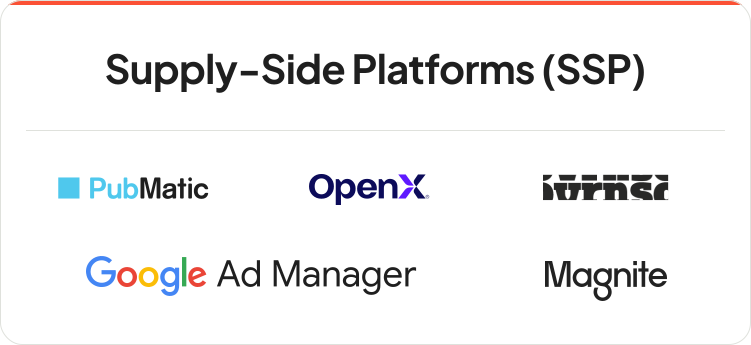
Supply-Side Platforms (SSP)
Supply-side platforms are used by publishers (for example, website owners, app developers, and content creators) to manage, sell, and optimize their available ad inventory. SSPs help them to do it in an automated and efficient manner. With the help of such platforms, publishers have the possibility to connect their inventory to multiple ad exchanges, demand-side platforms (DSPs), and networks. As a result, they can expose it to a broader range of potential advertisers without any manual intervention.
Pubmatic
It is one of the best-known SSPs in the market today. It allows independent publishers to take control over their digital advertising and successfully grow it. It helps marketers improve monetization by increasing their reach to target audiences across a wide range of ad platforms and formats.
OpenX
This programmatic ad tech company provides publishers with access to such important features as dynamic real-time bidding (RTB), precise inventory management, and advanced data analytics. Thanks to this, publishers who use this SSP can leverage enhanced data-driven decision-making and optimized ad placements.
Magnite
Among other best ad tech companies that offer supply-side platforms, we should name Magnite. This name became known in 2020, after the merger of two major SSPs, Telaria and Rubicon Project. Since that time, Magnite has made four successful acquisitions across AdTech and Martech domains. The new side-supply platform makes it possible to strengthen control over the process of selling their ad inventory with the help of Private Marketplaces (PMP), Auction Package, and Programmatic Guaranteed (PG) capabilities.
Sovrn
This platform is known as one of the most reliable ones in the industry. It boasts popularity among publishers who are looking for a new way to increase programmatic revenue and improve their optimized ad monetization. It has rich functionality. For example, the platform offers audience insights and can simplify a lot of tasks for users via its OneTag feature.
Google Ad Manager
Google is known for a wide range of digital tools for advertising and its SSP is one of them. It provides publishers with access to multiple ad exchanges and networks, such as Google’s AdSense, Ad Exchange, third-party networks, and third-party exchanges. Thanks to all the provided opportunities, publishers can significantly increase their potential revenue.
Our professionals have all the required skills and experience for building such platforms from scratch and modernizing the existing ones.
Want to hire experts in SSP development?
Our professionals have all the required skills and experience for building such platforms from scratch and modernizing the existing ones.
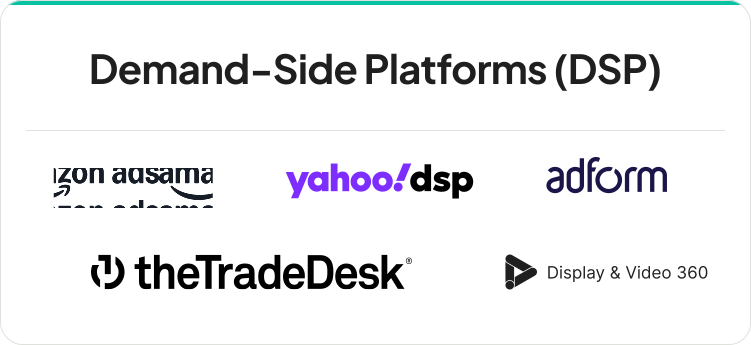
Such platforms let advertisers, agencies, and marketers automate the process of purchasing digital ad space across multiple channels in a single place. Advertisers have the possibility to submit their ad creatives to DSPs and further pay these platforms for impressions. Such platforms play an essential role in the modern AdTech ecosystem as they help brands reach their desired audiences quickly and easily.
Amazon DSP
Amazon Ads Agent (formerly Amazon DSP) is an omnichannel programmatic platform that helps advertisers reach target audiences on and off Amazon properties. It delivers agentic AI to support campaign planning and measurement across display, video, and audio ads. Advertisers can use natural-language commands to manage multi-channel campaigns through the conversational interface.
Yahoo DSP
Yahoo is next on our list of the best ad tech companies. Its DSP is known for a wide range of tools, solutions, and services that can offer businesses absolutely new digital marketing opportunities. The platform is powered by an AI engine that streamlines and facilitates the process of ad buying and makes all related efforts much more effective.
Display & Video 360 by Google
This platform helps businesses successfully execute their unique digital ad campaigns. With its tools, teams can design creatives, purchase inventory, and work with audience data. Users of this DSP can leverage a high level of transparency as they can always view how their budgets are spent and where their ads are running at any moment.
Adform
This DSP is enriched with a wide range of helpful features and benefits that can greatly increase the profitability of ad campaigns. It allows advertisers to reach their audience via the most demanded channels and formats, such as mobile and in-app ads, video and display digital ads, CTV, and OTT. The platform can generate reports both on demand and in real time, which makes working with the available insights more convenient.
The Trade Desk
Today, this DSP has a network of more than 200 publishing partners, including prominent names such as Spotify, Hulu, FOX, Disney, and ESPN. With its help, advertisers can successfully launch ad campaigns for different screens and devices. Such an approach can ensure broad reach and the highest results. RTB, PMP, Programmatic Guaranteed, and direct deals are among the features provided by the platforms.
Or maybe you have plans to launch your own self-serve ad platform for advertisers? Our AdTech software development team will be always ready to transform your ideas into real products.
Want to launch your own DSP?
Or maybe you have plans to launch your own self-serve ad platform for advertisers? Our AdTech software development team will be always ready to transform your ideas into real products.
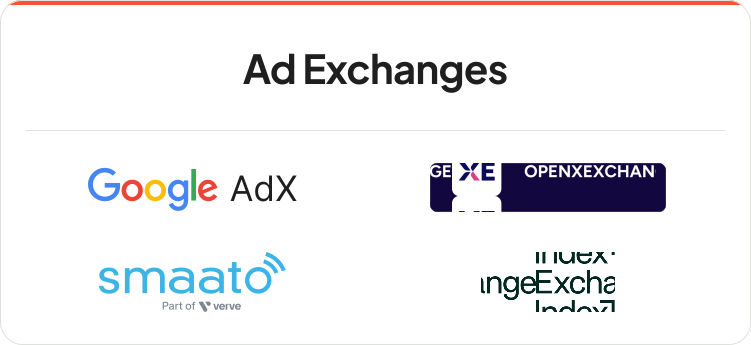
While discussing top AdTech companies, it’s also worth mentioning ad exchanges. Such platforms help facilitate programmatic ad deals. They allow publishers and advertisers to sell and buy ad inventory directly. This can be done via real-time bidding. This model makes it possible to eliminate the participation of intermediaries that are traditionally included in such transactions. Ad exchanges ensure high flexibility and transparency for both publishers and advertisers.
Google AdX (part of Google Ad Manager)
Google AdX is a premium programmatic marketplace where participants sell and buy digital ad space in real-time via automated private and direct auctions. Unlike ad networks that focus on selling clicks, this exchange helps publishers maximize revenue per impression. Although managed by Google, it doesn’t restrict demand sources to Google Ads. The ad exchange connects them to thousands of premium global demand sources, programmatic buyers, and rival ad networks.
OpenXExchange
This platform is well-positioned as a high-quality programmatic ad marketplace. It supports direct publisher relationships and offers innovative buying models. It has built an outstanding reputation as the largest independent ad exchange. Its network includes 1,200+ premium publishers, 50,000+ mobile applications, more than 34,000 advertisers, and over 400 buyers based in 190 countries worldwide. This ad exchange supports all screens and formats and opens instant access to global, US, and hyper-local inventory.
Index Exchange
This is an omnichannel marketplace known for its transparency and reliability for users. It offers marketers a wide range of possibilities to reach different groups of consumers through any ad format on any device. The list of available ad formats includes video, banner, connected TV (CTV), and native ads.
Smaato by Verve
Smaato is a great example of leading mobile AdTech platforms. It supports OpenRTB, ad network mediation, and real-time bidding, where publishers set floor prices for ad placements and demand partners bid against them. The ad exchange processes ad requests and places creatives in around 200 milliseconds, including the time spent on real-time bidding. And what is more important, publishers can control inventory management and programmatic sales using self-serve monetization tools.
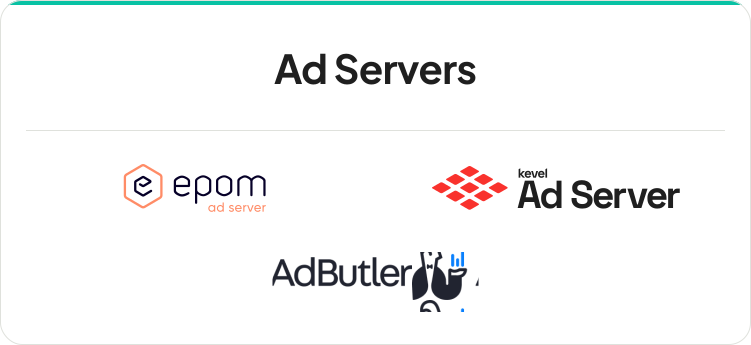
Ad Servers
Ad servers are systems that perform functions of a centralized platform for ad management. They are designed to make instant decisions on the most appropriate ads to be shown on a publisher’s website or application. In such a way, they greatly facilitate and enhance the process of displaying ads to users. Advertisers can rely on ad servers to manage their campaigns. They can upload ads, indicate the desired targeting options, set budgets, and schedule when and where their ads should be displayed. Moreover, ad servers can efficiently track ads’ performance based on metrics such as impressions, clicks, conversions, and other KPIs. Results can be further presented in the form of reports.
Epom Ad Server
Epom Ad Server is an enterprise-grade AdTech software that helps businesses manage cross-channel ad campaigns, automate optimization, and control their advertising ecosystem. It supports publishers, ad networks, and brands, offering tools for managing both supply and demand sides through a single, tree-like dashboard. The platform offers the functionality to launch campaigns, customize settings, and manage advertising operations across multiple channels.
Kevel Ad Server
Kevel offers a rich suite of ad serving APIs. They are smartly designed to enhance campaign management, reporting, and ad decision-making. The Ad Server provides access to the Kevel Forecast feature. It can demonstrate the potential performance of your ad against future and existing campaigns. Moreover, this solution also lets users power their ads with their custom machine learning segments, as well as ready-made targeting options based on geo, category, and keyword.
AdButler
This is an enterprise-grade ad server designed to manage cross-platform display campaigns for publishers, online retailers, digital marketplaces, directories, and other businesses that sell ad space. It offers API-based integrations, granular direct campaigns, real-time analytics, and custom or ready-to-use ad formats to help publishers manage campaigns and optimize ad revenue across digital channels. Multiple server locations and a global CDN infrastructure support fast ad delivery, with most placements served in milliseconds.
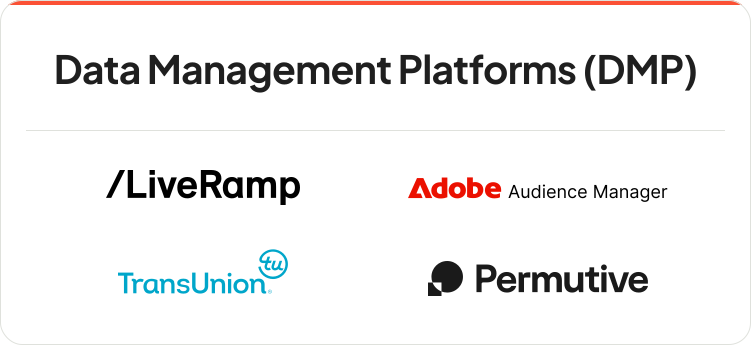
Data Management Platforms (DMPs)
These are centralized systems for collecting, organizing, and analyzing large volumes of data from multiple sources. The processed data is used to build audience segments for targeted advertising and marketing. In advertising, DMPs typically work with demographic data, ad engagement, on-site and in-app behavior, and other audience signals.
The DMP market has changed in recent years, with several major vendors discontinuing their products. Oracle exited the advertising business and shut down its BlueKai DMP in September 2024, while Salesforce retired Audience Studio earlier that year. CDPs, data clean rooms, identity resolution, and first-party data strategies now play a larger role in audience data management. Meanwhile DMPs remain useful for specific tasks, including audience segmentation and media activation.
Have you ever thought about building your own DMP?
This gives you full control over the technology and your audience data instead of relying on vendors whose roadmaps you can’t influence.
LiveRamp started with classic DMP capabilities and now focuses on data collaboration. Its platform helps businesses connect and enrich data, understand their customers better, and reach new audiences through segmentation and lookalike modeling. LiveRamp’s data marketplace lets companies buy and sell third-party data and set up second-party data partnerships.
Adobe Audience Manager
Audience Manager is Adobe’s DMP and part of Adobe Experience Cloud. It unifies first-, second-, and third-party data into audience segments for activation across media channels and integrates with Adobe Analytics and Adobe Target. It works best for companies already using Adobe’s marketing tools.
TransUnion TruAudience (formerly Neustar)
TransUnion acquired Neustar in 2021 and incorporated its identity data management capabilities into the TruAudience product line. It extends beyond the traditional DMP model, combining audience targeting with identity resolution and omnichannel consumer data, rather than relying primarily on third-party cookies.
The platform links people, households, and devices across online and offline touchpoints through an identity graph. It draws on signals from telecom providers, utilities, and financial services to help marketers refine audience segments and measure campaign performance across channels.
Permutive
Permutive grew out of the legacy DMP category and now positions itself as an audience platform for publishers and advertisers. It processes data in real time, largely on the user’s device, and lets publishers build and activate audiences from first-party data without relying on third-party cookies or ID tracking. This approach supports audience targeting in browsers with strict tracking restrictions, including Safari and Firefox.
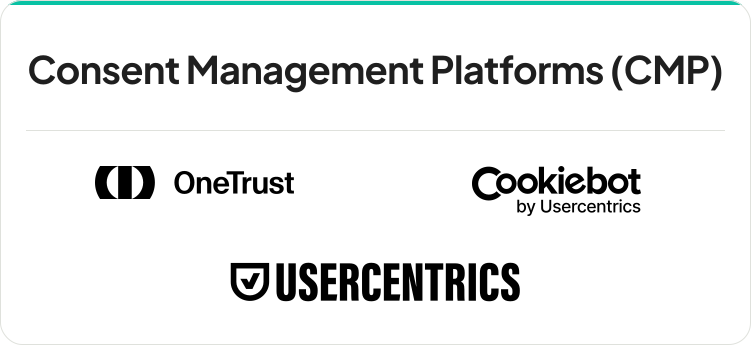
Consent Management Platforms (CMP)
As advertisers rely more on data collected directly from consumers, they need a clear way to record and manage consent preferences. CMPs help businesses collect consent, store user choices, and maintain records to comply with GDPR and CCPA.
OneTrust
OneTrust manages consent across websites, apps, and CTV/OTT channels. The platform helps businesses centralize user preferences and maintain consent records for privacy compliance.
Usercentrics
Usercentrics is a comprehensive CMP with built-in consent auditing tools. It is popular with teams that need to show compliance evidence, not just collect consent.
Cookiebot
Cookiebot automatically scans a site for cookies and trackers, groups them by purpose, and blocks non-essential ones until visitors give consent. The scanner generates a cookie declaration that documents each detected cookie’s provider, purpose, and expiration date, helping website owners keep their cookie information up to date.
OneTrust, Usercentrics, and Cookiebot handle the front-end consent flow. To use consented first-party data for audience segmentation, personalization, and ad targeting, businesses need additional tech layers, such as a DMP, CDP, or custom AdTech infrastructure.
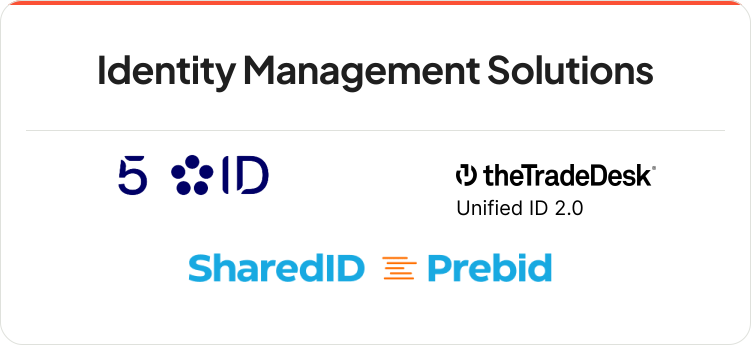
Identity Management Solutions
Identity solutions use shared or first-party identifiers to help publishers and advertisers match users with audience data, target ads, manage frequency, and measure campaign results. They connect data from multiple sources to build a more complete picture of each customer.
For advertisers, that means better targeting without relying on third-party cookies. A unified, traceable identity also helps businesses link audience data to its source and document whether it comes from consented interactions, supporting privacy compliance under regulations such as GDPR and CCPA.
ID5
ID5 provides a shared identifier that multiple publishers and advertisers can use to recognize the same user across a cookieless environment, without any single company owning that identity.
The Trade Desk’s Unified ID 2.0 (UID2)
UID2 is The Trade Desk’s open-source identity standard, designed to give publishers and advertisers a privacy-conscious alternative to third-party cookies. Publishers, advertisers, and AdTech platforms can use encrypted identifiers for audience targeting, cross-device frequency management, and campaign measurement.
Prebid SharedID
Prebid SharedID is a free, open-source first-party identifier that stores a pseudonymous user ID on the publisher’s domain and shares it with advertising partners. Managed by the Prebid community rather than a single commercial vendor, it gives publishers control over how user IDs are shared for ad targeting and frequency capping.
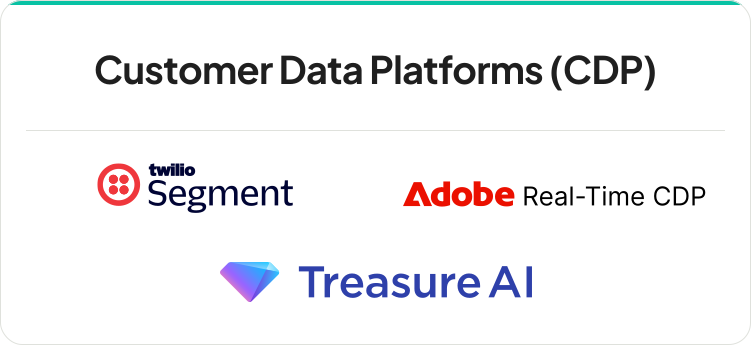
Customer Data Platforms (CDP)
Customer data platforms collect first-party data and personally identifiable information (PII) to enhance the efficiency of marketing communications. With such platforms, companies can create profiles of their existing clients, which can be applied to tracking their engagement via changes in such metrics as conversion and retention rates. The significance of CDPs is increasing in the current realities when third-party cookies are associated with a range of privacy-related concerns.
The description of CDPs may seem quite similar to DMPs. With the current changes in data privacy regulations, the distinction is becoming rather blurred. Nevertheless, it’s worth highlighting that CDPs are focused on marketing, first-party data, and “known” clients. DMPs traditionally organize audience data for advertising and media activation, often using pseudonymous identifiers and third-party data. Many now also work with first-party data and identity resolution to support audience activation under stricter privacy requirements.
CDP or DMP?
How to choose the right platform? And do you need to select only one?
Adobe Real-Time CDP combines online and offline data into real-time customer and account profiles, which marketers can use to build audiences and personalize campaigns. Built on Adobe Experience Platform, it connects with products such as Journey Optimizer and Customer Journey Analytics. Adobe is bringing agentic workflows into this ecosystem through CX Enterprise Coworker, an AI teammate for coordinating work across Adobe’s customer experience applications.
Twilio Segment
Twilio Segment collects real-time first-party data from websites, apps, and data warehouses, cleans it, and routes it to marketing tools, AI models, and agents. It resolves customer identities into unified profiles that teams use to build audiences and personalize campaigns. With the Conversation Memory integration, generally available since October 2026, Segment profiles also feed live conversations, giving human and AI agents customer context across voice, SMS, and WhatsApp.
Treasure AI
Treasure AI (formerly Treasure Data) shows how CDPs are evolving beyond customer data unification to support AI-driven marketing activities. The company rebranded in April 2026 and repositioned its product as an Agentic Experience Platform. Its CDP brings customer data together and resolves identities across channels. AI agents use these unified customer profiles to segment audiences, coordinate customer journeys, and personalize messages. Marketers set goals, define guardrails, and work with the agents through a conversational workspace, Treasure AI Studio.
Ad Networks
These companies function as bridges between advertisers and websites ready to host advertisements. They aggregate ad supply from publishers and help match it with the advertiser demand. They simplify the ad buying process by offering advertisers access to a broad range of placements across different websites and apps, typically through a single interface. Many of the biggest AdTech companies offer ad networks and access to their ad servers in tandem, making such turnkey solutions more appealing for publishers.
Google AdSense
Google AdSense is one the most widely used ad networks for publishers of all sizes. It connects websites with Google’s advertiser demand and fills ad slots with display, native, and in-feed formats. Its Auto ads feature automatically places and adjusts ad size to fit the available space. Publishers earn revenue from ad impressions and can control which ad categories and advertisers appear on their inventory. With relatively low entry barriers, AdSense is a common starting point for website monetization, while larger publishers may turn to Google Ad Manager or header bidding setups.
Taboola
Taboola is a major ad network on the open web, best known for content recommendations and native ads on publisher sites. Its Realize platform extends beyond native advertising, giving buyers access to display and video inventory across premium publishers such as NBC News and devices like Samsung and Xiaomi. In 2026, Taboola introduced Realize+, an AI system that automates targeting, creative generation, and placement decisions for performance campaigns.
BidVertiser
BidVertiser is a self-serve direct advertising network that automatically matches advertisers and publishers. The platform specializes in affiliate marketing, conversion optimization, and traffic screening to detect fraud and malware. The network offers segmented programmatic traffic, with targeting controls over geo, sub-IDs, devices, time of day, and specific user agents.
Agency Trading Desks (ATD)
Agency trading desks emerged in the early 2010s as dedicated units within holding companies that planned, bought, and optimized programmatic media for agency clients. Most of them have since been dissolved or absorbed. This is because advertisers started to demand more transparency into agency fees and media buying, and many brands also began bringing programmatic buying in-house.
Holding companies responded by embedding programmatic specialists in their media agencies and building their own platforms that connect data, planning, and buying. The trading desk function still exists, but it now operates within these broader systems rather than a separate business unit.
Omnicom Media
Omnicom previously ran Accuen, one of the industry’s first agency trading desks. As clients sought more control over media spend, Omnicom moved its programmatic specialists out of the standalone desk and into its media agencies. After acquiring IPG in late 2025, the group brought OMD, PHD, Hearts & Science, UM, Initiative, and Mediahub under a single Omnicom Media unit. Programmatic planning and buying now run through Omni, the group’s marketing operating system, while Acxiom provides the identity and data layer.
WPP Media
WPP Media is WPP’s media operating unit, formerly known as GroupM. Its programmatic business grew out of Xaxis, one of the largest trading desks of the 2010s. Today, WPP Media connects media, data, and partnerships through WPP Open, the group’s AI-powered marketing platform. This way, the company connects programmatic buying with the broader media planning and measurement process.
Full-Stack AdTech Platforms
Such platforms often function as one-stop solutions for publishers and advertisers, offering access to a full range of tools that could be needed in their work.
Adoppler (now part of ElementalTV)
Adoppler is a full-stack video monetization platform originally developed by Geomotiv. It later became a standalone company and is now part of ElementalTV. As a full-stack solution, it combines SSP, DSP, and ad exchange functionality with advanced tools for direct, programmatic, and PMP deals as well as third-party supply and demand management.
Adoppler has a built-in ad server for direct campaigns and unified auctions, along with header bidding, video transcoding, and ad delivery capabilities. It supports VAST tags, OpenRTB 2.x, and Prebid Server inventory sources.
The platform integrates with major programmatic buyers, including Magnite, Unruly, Smaato, PubMatic, Xandr, and FreeWheel, as well as audience data providers such as LiveRamp and Neustar. Creative allow/block lists and custom real-time reports help manage ad quality and monitor inventory performance.
Want to find out how this solution was built?
We shared the project details in our success stories section.
Admixer is an independent AdTech company that builds full-stack programmatic solutions for brands, publishers, and agencies. Its product line covers both sides of the market, including an ad server for publishers, an SSP, a DSP, and a DMP. This lets Admixer build local ad ecosystems and work with niche audiences and inventory. The company serves 3,000+ clients worldwide, has a team of 250+ people, and works with 100+ demand and supply partners.
SmartyAds
SmartyAds is a full-stack programmatic platform with its own DSP, SSP, and ad exchange for omnichannel media buying and monetization. Advertisers and agencies can run campaigns across display, mobile, video, CTV, and audio, while publishers sell inventory through the same marketplace. The platform uses machine learning to optimize bidding and campaign performance. In 2026, SmartyAds moved its white-label products into a separate brand, Teqblaze, so the core business now focuses on self-serve buying and selling.
AdTech Development Companies
When talking about the ad tech ecosystem, it is impossible not to mention companies that build, maintain, and modernize digital solutions to meet publishers’ and advertisers’ continuously changing needs. Such teams need not only a rich tech background and solid programming skills but also exclusive expertise in this particular domain.
Geomotiv
Geomotiv is a custom software development company with over 16 years of industry expertise, specializing in AdTech, MarTech, and Linear/OTT TV platforms. The company builds high-load, AI-driven systems, including custom DSPs, SSPs, programmatic Retail Media Networks (RMNs), and unified ad servers.
Geomotiv works with brands, digital agencies, and major publishers, offering IT staff augmentation and dedicated teams to match different project needs. Businesses can also hire AdTech developers with hands-on industry experience who already understand programmatic advertising and the systems they’re building.
The company’s delivery processes follow ISO-certified quality and security standards, supporting long-term software development partnerships.
How Geomotiv Helped MediaMath Increase Revenue by 30%.
Geomotiv has been MediaMath’s dedicated AdTech team for 5+ years, building the campaign automation layer inside its integrated DSP and DMP. The long-term partnership helped MediaMath expand its platform capabilities and increase revenue by 30%.
Oxagile has over 20 years of experience in software engineering and consulting services for the AdTech domain. Its developers design and implement custom solutions for programmatic advertising, including CTV environments, Retail Media setups, real-time bidding infrastructure, and audience targeting algorithms. The company focuses on building applications from scratch and modernizing legacy ad platforms.
Xenoss
Xenoss has been developing custom software in the MarTech, AdTech, and data engineering segments for over 10 years. The company develops infrastructure for high-load platforms, including RTB architecture, supply and demand-side systems, predictive data modeling, and ML components. Its clients range from AdTech and MarTech vendors to brands, media agencies, and publishers building or expanding their advertising technology infrastructure.
Intellias
Intellias has been providing software engineering and technology integration services for 24 years, including custom development for the digital advertising industry. Its services include product engineering from scratch, integrating third-party marketing services, and performing UI/UX redesign. The team also conducts performance and architecture audits to optimize existing software components.
Final Word
As we can see today, despite its comparatively short history, the AdTech industry is already quite mature. Its landscape is continuously expanding and welcoming new names and solutions. Like many other modern ecosystems, it is quite flexible and dynamic. And it greatly reflects the majority of the latest trends observed in the tech world.
The future of the ad tech ecosystem is shaped by a combination of technological advancements, regulatory pressure, and quickly changing consumer expectations. At the current moment, it is possible to presuppose that in the near future, the industry’s development will concentrate on privacy, transparency, and ethical practices in advertising. Among the most promising technologies for the market, these days, experts name AI and blockchain.
Given the current state of the market, the demand for such products is expected to continue growing. If you want to enter this industry with your custom software or launch an AdTech solution for your company’s needs, you should have a reliable development partner by your side. A professional team like Geomotiv can become an excellent choice for you.
Our specialists have rich expertise in this domain and will be able to build the most efficient digital solutions for ad monetization and revenue growth.
Such companies offer digital solutions that help manage, deliver, and optimize digital advertising campaigns. The provided tools automate ad buying and selling, track ad performance, and target audiences more effectively.
What do AdTech companies do?
AdTech companies serve as intermediaries between advertisers and publishers. By leveraging the power of data and technology, they create efficiencies, enhance targeting precision, and maximize the impact of advertising budget allocation.
What is the ad tech industry?
The ad tech industry is crucial in the modern digital marketing landscape. It represents the ecosystem of companies, tools, and platforms that facilitate digital advertising buying, selling, delivery, and management.
What's the difference between a CMP, a DMP, and an identity management solution?
A CMP collects and records users’ consent preferences for data collection and use. A DMP organizes audience data into segments that advertisers can use to improve targeting. An identity management solution links identifiers across data sources to help recognize the same user across advertising environments, including those where third-party cookies are unavailable. In an advertising stack, each serves a different purpose:
Consent management records users’ choices;
DMPs organize audience data for targeting.
Identity solutions help create unified user profiles.
Looking to build a successful custom software solution? Our experienced development team is ready to assist.
Thank you! We'll get in touch very soon.
Also you can book a call with our senior manager
Cookie Consent
We as well as our partners use cookies to enhance your browsing experience, analyze site traffic, and personalize content. For more details, see our Cookie Policy.
FunctionalAlways active
The technical storage or access is strictly necessary for the legitimate purpose of enabling the use of a specific service explicitly requested by the subscriber or user, or for the sole purpose of carrying out the transmission of a communication over an electronic communications network.
Preferences
The technical storage or access is necessary for the legitimate purpose of storing preferences that are not requested by the subscriber or user.
Statistics
The technical storage or access that is used exclusively for statistical purposes.The technical storage or access that is used exclusively for anonymous statistical purposes. Without a subpoena, voluntary compliance on the part of your Internet Service Provider, or additional records from a third party, information stored or retrieved for this purpose alone cannot usually be used to identify you.
Marketing
The technical storage or access is required to create user profiles to send advertising, or to track the user on a website or across several websites for similar marketing purposes.