Reliable and productive AdTech solutions ensure reaching business goals faster and more efficiently for AdTech companies, digital agencies, publishers, and brands.
Our retail media services help brands and retailers boost revenue through data-driven advertising. We specialize in programmatic ads, audience targeting, and AI-powered analytics, enabling personalized, high-impact campaigns. With expertise in retail media networks, ad monetization, and omnichannel strategies, Geomotiv maximizes customer engagement and sales.
Our experienced team of developers, fresh off successful projects with Pluto TV and Paramount, is ready to elevate your next Adtech or Video Streaming solution.
Geomotiv partners with leading companies across streaming, media, gaming, audio, CTV, retail, and RMNs to build custom AdTech solutions aligned with their business goals.
Geomotiv lets you access an ideal dedicated development team whenever you need to complete your in-house team or create a standalone R&D department within your company.
From a small app to a comprehensive platform-level project, Geomotiv can develop and implement custom software solutions that involve extensive Big Data usage, storage, management, and processing.
We will help you to drive your business growth with innovative AI and ML services by automating routine processes, expanding your app features, and increasing the accuracy of business predictions.
At Geomotiv, we specialize in delivering innovative solutions that drive sustainable growth and success for your business. Let us help you transform your vision!
Get In Touch
USA (Headquarter)
700 N. Fairfax suite 614, Alexandria VA, 22314 United States
Europe
Rua Viriato 27-3A, 1050-234 Lisbon, Portugal
Western Asia
14 Paronyan St., Bln. 6, 0009 Yerevan, Armenia
Middle East
Al Marsa Street Marina Plaza, Level 27 Dubai, United Arab Emirates
HomeBlogIndustriesHow to Build Your Own DSP: Step-by-Step Guide to Building a Custom Demand-Side Platform
Published: May 5, 2026
How to Build Your Own DSP: Step-by-Step Guide to Building a Custom Demand-Side Platform
Ownership shift: A custom DSP transforms your advertising infrastructure from a rented service into a fully owned system that you can optimize without vendor limitations.
Full control: A proprietary DSP gives you complete control over bidding logic and turns your algorithms into valuable intellectual property.
Gradual scaling: Successful DSP launches should start with limited traffic and scale only after validating performance and cost efficiency.
Strategic choice: Your decision between building, buying, or white-labeling depends on your budget and the level of customization required.
Best fit: Building your own DSP is most beneficial for companies with large ad budgets, unique first-party data, or highly customized bidding requirements.
When you use an off-the-shelf demand-side platform (DSP), you are likely paying a 15% to 30% tech tax on every programmatic ad you buy. While true, building your own means you now bear the liability of scale. If your algorithm bugs out and overspends $100k in an hour, there is no “SaaS partner” to negotiate a credit with. You own the risk.
Moreover, you have zero visibility into the actual auction dynamics. All this can become a serious barrier to your business growth.
The decision to build your own DSP can fully change the game. It shifts your ad spend from a rented service to an owned asset.
In this article, we are going to talk about the benefits of this model and explain when it makes sense to invest in custom development.
What is a Custom DSP?
A custom DSP is proprietary infrastructure engineered to execute programmatic ad buying without the middleware.
Off-the-shelf DSPs often operate as black boxes. You hand over your budget. And they abstract the bidding logic, apply generic algorithms, and extract a margin on every transaction. You have zero visibility into the actual auction dynamics.
A custom DSP changes the architecture. You own the entire stack. In this case, a SaaS vendor doesn’t dictate your capabilities. Instead, you connect directly to supply-side platforms (SSPs) and ad exchanges via OpenRTB protocols.
This requires coordination of the following critical components:
Bidder. It must ingest and evaluate hundreds of thousands of queries per second and return bid responses within 100 milliseconds to prevent timeouts.
Data orchestration. It replaces manual CSV uploads with real-time API integrations, feeding your first-party CRM data directly into the scoring models.
Custom algorithms. You can deploy your own machine learning models optimized for your exact margins.
Technically, custom DSP development redirects your ad spend from a rented service to an owned asset. Your bidding logic becomes intellectual property. And you can control the exact mechanics of how your capital is deployed in the bidstream.
What You Gain When You Build Your Own DSP from Scratch
Quite often, businesses reject the idea of building their own custom software due to high initial investments. However, it’s crucial to keep in mind that the launch of your own DSP helps you solve the structural bottlenecks that limit campaign ROI.
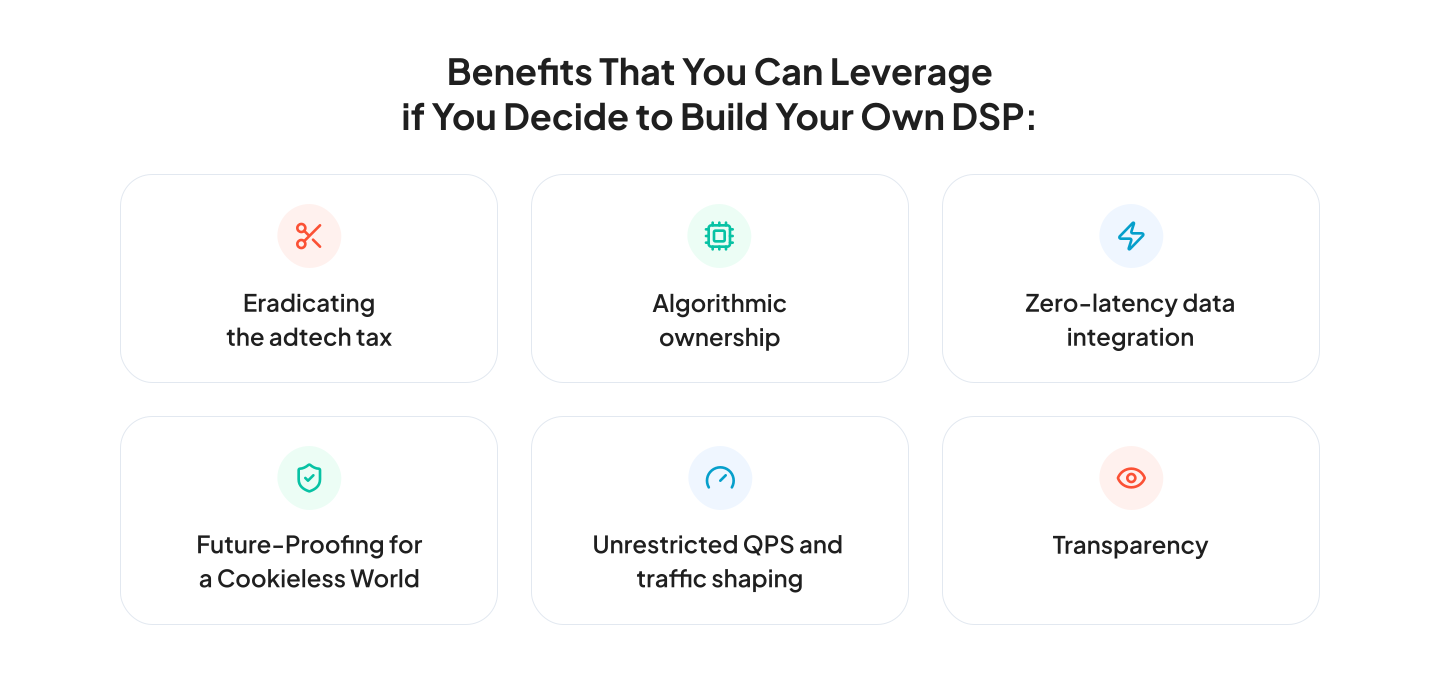
Let’s take a closer look at the benefits that you can leverage if you decide to build your own demand side platform.
Eradicating the adtech tax. Rented DSPs extract a 15% to 30% margin on your media spend. When you own the infrastructure, that capital goes directly into the bid.
Algorithmic ownership. Off-the-shelf platforms use generalized machine learning models designed to work for thousands of different clients. Custom infrastructure lets you deploy proprietary predictive models.
Zero-latency data integration. Batch-uploading audience lists to a third-party platform leads to synchronization delays. As a result, data can become obsolete before the bid even happens. A custom DSP enables real-time API orchestration. Your bidder reads directly from your internal data warehouse. It means that your DSP can adjust bids based on inventory levels or user state changes that occurred milliseconds prior.
Future-Proofing for a Cookieless World. The industry is moving away from third-party cookies toward privacy-centric frameworks like Apple’s ATT and Google’s Privacy Sandbox. Off-the-shelf DSPs often use generic, “one-size-fits-all” approaches to these changes.
The Advantage: Building a custom DSP allows you to deploy proprietary Topics API or PAAPI (Protected Audience API) logic.
The Result: You can build your own “First-Party Identity Graph” that doesn’t rely on disappearing cookies, giving you a massive competitive edge in bidding accuracy that a generic SaaS platform simply cannot match.
Unrestricted QPS and traffic shaping. SaaS DSPs can limit your queries per second (QPS) to manage their own cloud compute costs. Building DSP software from scratch lets you engineer highly optimized listening endpoints. While “dropping” worthless impressions saves on your bidding engine’s CPU, keep in mind that listening is not free. To drop an impression, your system must still “handshake” and parse the packet to see what it is. In a 1-million QPS environment, the sheer bandwidth cost of simply listening can bankrupt a project before a single bid is placed. Real-world DSPs use Supply Path Optimization (SPO) and pre-filtering logic at the load balancer or “Edge” level (using tools like NGINX or HAProxy). By filtering by App ID, Publisher, or Geolocation at the very entry point, you prevent low-value traffic from ever reaching your expensive application layer.
Transparency. When you build a DSP, you stop relying on aggregated vendor dashboards. Every bid request, timeout, win, and loss is written directly to your proprietary data lake. This log-level data is required to train superior bidding algorithms and audit your supply paths for hidden intermediary fees.
Building DSP Solutions: Budget, Team, and Timeline
Building a DSP is not like building a standard web app; you are building a High-Frequency Trading (HFT) engine. Generic developers will fail because they don’t understand “Garbage Collection” pauses or “UDP vs TCP” optimization at the kernel level.
Required skills: How to assemble the right team
When it comes to AdTech solutions, generic full-stack developers will struggle with such tasks. You need professionals who understand the peculiarity of this niche and have experience with network protocols. Based on our experience in DSP development, we can propose the following team structure.
Lead systems architect (1). Must have a background in Low-Latency systems (FinTech or AdTech). They don’t just write code; they manage the Linux Kernel tuning and Memory Management to ensure the bidder doesn’t “hiccup” under a 500k QPS load.
AdTech Protocol Engineer (1): A specialist in OpenRTB (2.5 – 3.0) and Identity Frameworks. Their job is to integrate UID2.0, ID5, and Privacy Sandbox APIs. Without this, your DSP is “blind” in a cookieless world.
Infrastructure & Edge Engineer (DevOps) (1). Responsible for Traffic Shaping and Egress Management. They must be experts in Anycast routing and Load Balancing (NGINX/HAProxy) to drop 90% of non-matching traffic before it hits the expensive application layer.
Technical Product Manager (1): The “Bridge.” They translate OpenRTB specs into business logic and manage SSP Relationships (getting the “Seat”) and compliance (ads.txt, sellers.json, and GDPR/CPRA consent strings).
The “Real World” budget and ongoing bills
The original $15k–$40k estimate is a baseline for a “Quiet” DSP. If you intend to scale and actually compete for premium inventory, the math changes significantly due to Data and Connectivity fees.
The Upfront Build: $550,000 – $900,000
This increase accounts for the Integration Debt:
Identity Integration: $50k+ for implementing decentralized ID solutions.
SPO (Supply Path Optimization) Logic: Building custom paths to bypass high-fee intermediaries.
Testing/Certification: SSPs often require a “Proof of Spend” or a technical audit before granting a high-volume QPS seat.
The Monthly “Burn”: $35,000 – $100,000+
Expense Category
Estimated Monthly Cost
The "Hidden" Reality
Cloud/Bare Metal
$20,000 – $60,000
Egress Fees: Moving data out of the cloud is expensive. Most mature DSPs move to "Bare Metal" (Equinix/Packet) to avoid the "Cloud Tax."
SSP Seat Fees
$5,000 – $15,000
Some top-tier SSPs charge a monthly "Minimum Commitment" or a platform fee if your "Bid-to-Win" ratio is too low.
Data & Identity
$10,000 – $25,000
Accessing 3rd-party segments (Eyeota, BlueKai) or Identity graphs (LiveRamp) involves flat fees or "CPM surcharges."
Fraud/Brand Safety
$5,000 – $10,000
You cannot self-audit. You must pay vendors like IAS or DoubleVerify to ensure you aren't buying bot traffic.
Timeline
As well as the budget, the timelines are influenced by your business needs. However, as a rule, a production-ready baseline takes 6 to 9 months.
Time Period
Core activities
Milestone
Months 1 to 3
Engineers focus entirely on the underlying math and data processing. There is no user interface or dashboard yet.
The system can successfully read a bid request, run your custom pricing logic, and send a valid response in under 100 milliseconds.
Months 4 to 6
The team connects the engine to the global ad exchanges.
Your servers prove they can handle high-speed traffic without lagging or sending errors back to the exchange.
Months 7 to 9
The system goes live, but you restrict the flow to just 1% of the total global traffic. Your team builds filters to automatically block bot traffic.
You slowly open the traffic tap. You monitor the data closely to ensure your server costs align with your actual revenue before scaling to full capacity.
Step-By-Step Plan: How to Build Your Own DSP
If you are planning to build a DSP, you should clearly understand how the development process will be organized. The step-by-step guide provided below covers the main stages that will help you launch a resilient and efficient platform.
Step 1. Define your goals, KPIs, and budget
Do not build a generalist DSP to compete with industry giants like The Trade Desk. Define an exact niche (like CTV or hyper-local mobile ads) and goals. Set a strict monthly limit on what you are willing to spend on server costs before a single line of code is written. Without a cap, the sheer volume of bid requests can drain your budget in days.
Step 2. Build the engineering core team
You need a team that specializes in high-speed networking. Your lead engineers must understand how to process data in under 1/10th of a second.
If your system takes too long to “think” about a bid, the marketplace will simply cut your connection to protect its own performance.
Step 3. Design the system architecture
This step is about building your core engine. Think of your DSP as three distinct parts working in sync:
The Bidder: The program brain that decides which ads to buy in real time.
The Memory: A fast-access storage system that tracks your remaining budget every millisecond so you don’t overspend.
The Ledger: A massive database that records every win and loss for later reporting.
Step 4. Pass the marketplace stress test
Ad marketplaces don’t just let anyone join. You must pass a rigorous technical certification including OpenRTB 2.5/2.6 compliance, ads.cert, and sellers.json validation. During this phase, exchanges will flood your system with test traffic to ensure your servers don’t crash under pressure. You must prove that your engine can handle these bursts without lagging or returning malformed bid responses.
Expert Note:The Liquidity Gap
While the ultimate goal is to connect directly to save on fees, global giants like Magnite, PubMatic, and Index Exchange act as gatekeepers. They often have strict minimum monthly spend requirements and “per-seat” fees.
If your projected initial volume is low, you may find it impossible to secure a direct seat immediately, potentially forcing you into a “middleware” or sub-seat arrangement – the very scenario a custom build aims to avoid.
Secure Letters of Intent (LOIs) from mid-tier SSPs first to prove your volume and technical stability before approaching the “Big Three.”
Step 5. Ship an MVP that proves the core value
Your first version should not have a pretty dashboard or a login screen. It should only be an engine that can successfully buy an ad and record the result.
Prove the system is stable before you spend money on a user interface.
Step 6. Load testing, fraud checks, and privacy compliance
The moment your system goes live, it will be hit by botnets and fraudulent traffic. You must build pre-bid filters to automatically ignore suspicious requests.
In addition to this, your team should take care of privacy compliance. Your system should be ready to handle global privacy laws, such as GDPR, for example.
Automatically dropping illegal or fake traffic saves you massive amounts in wasted server costs and potential fines.
Step 7. Launch, optimize, and scale to new channels
Do not turn the system on to 100% capacity on day one. Start with a tiny volume of bids (it can be 1% of your target traffic). Monitor your server utilization and your win rate closely. As the math stabilizes and you prove the ROI, you can slowly open the tap to full volume.
Pro-Tip: The “Supply Scarcity” Warning
The biggest risk to a custom DSP isn’t the code – it’s Supply. In 2024-2026, SSPs are “pruning” their connections. They no longer want 500 small DSPs hitting their servers; they want 50 high-quality ones.
Before writing code, a business must secure LOIs (Letters of Intent) from at least three major SSPs. If they won’t give you a seat, your custom DSP will have no inventory to buy.
Build, Buy, or White-Label DSP: How to Make the Right Decision
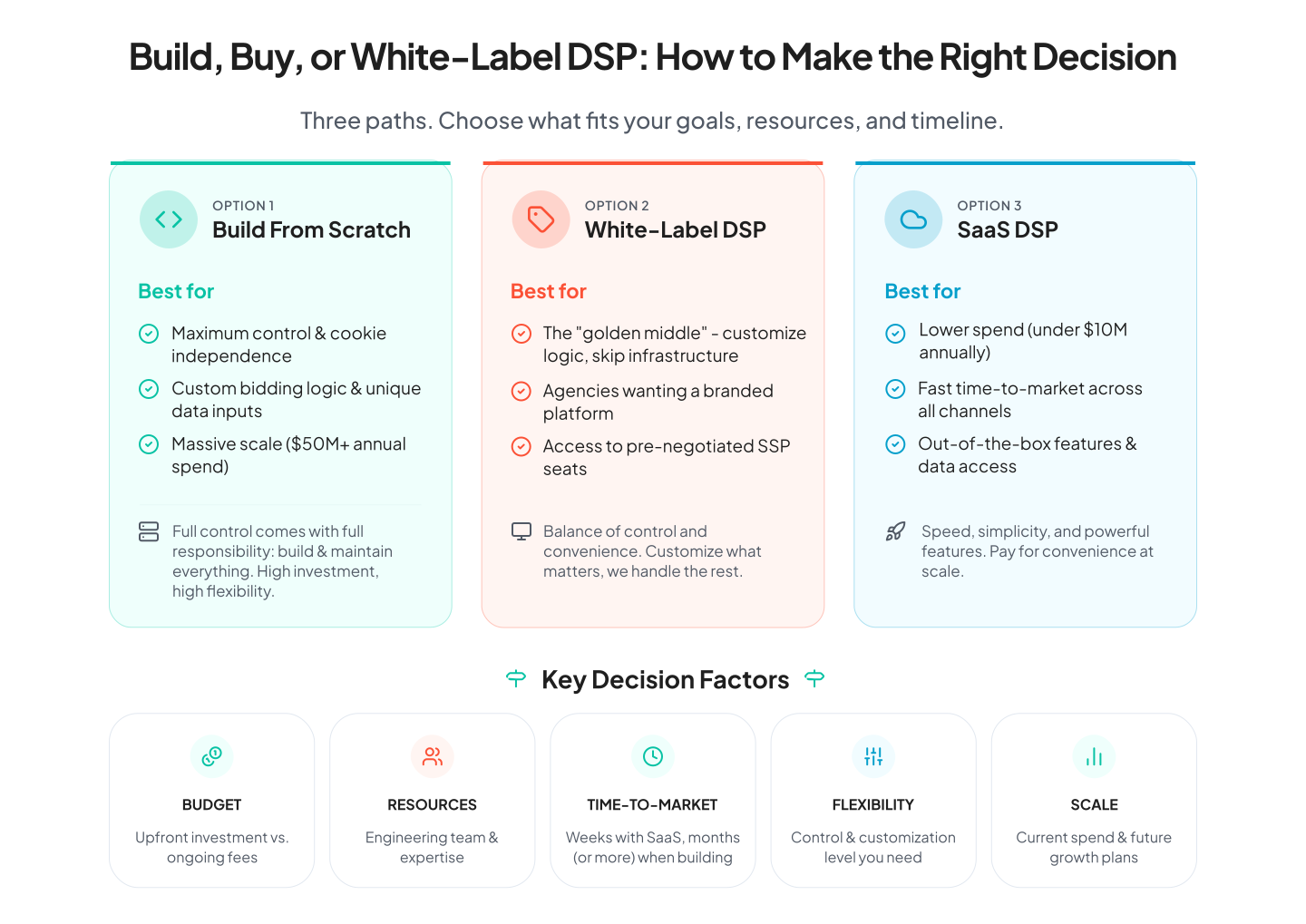
Choosing between building, buying, or customizing a white-label DSP is a typical architectural crossroads. The prospect of eliminating SaaS fees by building in-house is a good way to reclaim margin. However, you should be prepared for other expenses related to the maintenance of the infrastructure required for managing sub-100ms bid cycles.
We recommend considering different approaches to introducing a DSP into your digital advertising strategy. This will help you choose the option that is the most beneficial for your business.
Option 1. Building DSP solutions from scratch
Build a DSP if you need granular algorithmic control that no off-the-shelf product can provide.
When to choose this:
Cookie Independence. You want to move beyond third-party cookies and need a custom environment to test and scale Privacy Sandbox or UID2.0 integrations without being limited by a vendor’s roadmap.
Custom bidding logic. Your business model relies on a specific math variable (like weather-based triggers or real-time retail inventory levels) that standard DSPs can’t ingest fast enough.
Massive spend scale. Your annual ad spend exceeds $50 million. At this volume, the 20% tech tax of a commercial DSP exceeds the cost of a dedicated 5-person engineering team.
In the case of custom development, you are creating a high-concurrency distributed system that must maintain 99.9% uptime while processing millions of requests per second. To handle that task properly, you need to have a reliable engineering team by your side. If you don’t have such experts in-house, you should find a reliable AdTech development partner.
Option 2. Customizing a white-label DSP
If you want the brand authority and customized logic of your own platform, but you are not ready to invest in full-scale development from scratch, using a white-label solution can be the most appropriate option.
When it is a suitable model:
The “golden middle”. You need to write custom bidding scripts, but don’t want to handle complex tech processes, like the SSP integrations, the OpenRTB certifications, and the global server scaling. Your developers will focus on optimization logic, not on infrastructure maintenance.
Niche agencies. You want to provide a branded interface to your clients to increase loyalty and recognition.
Benefit of White-Label. Immediate access to pre-negotiated SSP seats if you cannot meet the high minimum spend required for a direct custom seat.
With a white-label platform, you can customize some features and tools, but these capabilities are still limited.
Option 3. Using a SaaS DSP
This approach presupposes using a plug-and-play solution provided by one of the established players like The Trade Desk, Google DV360, or Amazon DSP.
When this option is for you:
Under $10m annual spend. The math on a custom build or even a white-label setup simply does not pencil out at this tier.
Time-to-market. You need to be live on CTV, mobile, and web across 50+ exchanges by next Tuesday.
Feature parity. You need out-of-the-box access to third-party data segments and advanced attribution modeling that would take quite a long time to build in-house.
Wrapping Up
The decision to build DSPs from scratch isn’t just about technology. Very often, it is mainly about efficiency. When you own the engine, you can strip away everything that isn’t working and focus your budget on the specific audiences that grow your business. It’s a transition from a one-size-fits-all tool to a high-performance machine designed exactly for your needs.
Unsure if your annual spend justifies a custom build?
With more than 16 years of experience in AdTech, our team is always ready to help you! We will compare what you will pay in software fees over the next two years against the true upfront price and ongoing server bills of building your own system.
Why does it make sense to build a custom DSP instead of using an established platform like The Trade Desk?
Creation of your own platform will provide you with data sovereignty and specialized control. If you have unique first-party data that gives you a competitive edge, or if you need a custom bidding algorithm that standard platforms don’t support, custom development is the only way to own that intellectual property.
How can I understand that my company is ready to launch its own DSP?
We usually recommend considering such projects when your annual ad spend or managed spend exceeds $10 million, or when you have a specific technical requirement that current SaaS tools cannot meet. If you are simply trying to save on a 15% platform fee, the engineering payroll for a custom build will likely cost more than the fees you want to avoid.
If I build a DSP, can I sell access to it to other companies?
That’s exactly how many companies recoup their development costs. When you have a stable, certified bidding engine, you can turn it into a SaaS product for other agencies or advertisers. This transforms your internal tool into a scalable revenue-generating asset.
Fill out the form below and we’ll get in touch within 24 hours
Software development expertise and senior tech talent for AdTech and Streaming Media projects.
Contact Us
Fill in the form
Thank you! We'll get in touch very soon.
Also you can book a call with our senior manager
We will be glad to see in our team!
Fill in the form
Thank you! We'll get in touch very soon.
Also you can book a call with our senior manager
Get a Free Consultation
Looking to build a successful custom software solution? Our experienced development team is ready to assist.
Thank you! We'll get in touch very soon.
Also you can book a call with our senior manager
Cookie Consent
We as well as our partners use cookies to enhance your browsing experience, analyze site traffic, and personalize content. For more details, see our Cookie Policy.
FunctionalAlways active
The technical storage or access is strictly necessary for the legitimate purpose of enabling the use of a specific service explicitly requested by the subscriber or user, or for the sole purpose of carrying out the transmission of a communication over an electronic communications network.
Preferences
The technical storage or access is necessary for the legitimate purpose of storing preferences that are not requested by the subscriber or user.
Statistics
The technical storage or access that is used exclusively for statistical purposes.The technical storage or access that is used exclusively for anonymous statistical purposes. Without a subpoena, voluntary compliance on the part of your Internet Service Provider, or additional records from a third party, information stored or retrieved for this purpose alone cannot usually be used to identify you.
Marketing
The technical storage or access is required to create user profiles to send advertising, or to track the user on a website or across several websites for similar marketing purposes.