Reliable and productive AdTech solutions ensure reaching business goals faster and more efficiently for AdTech companies, digital agencies, publishers, and brands.
Our retail media services help brands and retailers boost revenue through data-driven advertising. We specialize in programmatic ads, audience targeting, and AI-powered analytics, enabling personalized, high-impact campaigns. With expertise in retail media networks, ad monetization, and omnichannel strategies, Geomotiv maximizes customer engagement and sales.
Geomotiv partners with leading companies across streaming, media, gaming, audio, CTV, retail, and RMNs to build custom AdTech solutions aligned with their business goals.
Scale your engineering capacity with offshore software development services. Access experienced engineers to optimize costs, reduce hiring overhead, and bring custom software solutions to market faster.
From a small app to a comprehensive platform-level project, Geomotiv can develop and implement custom software solutions that involve extensive Big Data usage, storage, management, and processing.
We will help you to drive your business growth with innovative AI and ML services by automating routine processes, expanding your app features, and increasing the accuracy of business predictions.
At Geomotiv, we specialize in delivering innovative solutions that drive sustainable growth and success for your business. Let us help you transform your vision!
Get In Touch
USA (Headquarter)
700 N. Fairfax suite 614, Alexandria VA, 22314 United States
Europe
Rua Viriato 27-3A, 1050-234 Lisbon, Portugal
Western Asia
14 Paronyan St., Bln. 6, 0009 Yerevan, Armenia
Middle East
Al Marsa Street Marina Plaza, Level 27 Dubai, United Arab Emirates
HomeBlogIndustriesHow Agentic AI Is Replacing Manual Bidding in Programmatic DSPs
Published: May 15, 2026
How Agentic AI Is Replacing Manual Bidding in Programmatic DSPs
From prediction to execution: Unlike standard machine learning algorithms, which only predict outcomes, agentic AI acts as an autonomous execution layer and closes the transaction typically between 100–300ms, depending on the exchange and inventory type.
Closing the 21-hour latency gap: Manual bidding relies on “human middleware” that often takes 24 hours to react to trends. Agentic AI eliminates this delay.
Solving the averaging problem: Agentic systems bid on individual events rather than audiences and value every impression in real time.
Privacy-first performance: Agentic AI bypasses the cookieless identity gap by shifting from tracking IDs to analyzing high-dimensional signals like semantic context and real-time engagement.
The future of embedded autonomy: The industry is moving toward Agentic Real-Time Frameworks, where AI agents reside directly within exchange hardware to perform multi-layer inference.
A typical webpage load takes 1–5 seconds. In that same window, a modern demand-side platform (DSP) must evaluate, price, and buy an ad slot among millions of competitors.
Programmatic advertising has always been automated. But it has rarely been autonomous. Agentic AI is changing the job description of the modern trader. By shifting from predictive models to autonomous agents, DSPs are moving beyond mere math and into true decision-making.
In this article, we explore how agentic AI is replacing manual bidding structures and why this autonomy is becoming a technical reality.
What is Agentic AI in Programmatic Advertising?
Agentic AI is an autonomous execution layer. It shifts machine learning from a passive prediction tool to an active participant in the bidstream.
Standard machine learning stops at prediction. It calculates a probability score and waits. Agentic AI takes the final step. It executes the transaction. In a DSP, this architecture replaces the manual ad operations workflow with a system that acts directly on the bidstream.
Traditional programmatic buying relies on human middleware. Media traders review aggregated dashboards and extract log-level data into spreadsheets. They manually adjust bid multipliers and shift budgets across line items. This creates massive operational latency.
The OpenRTB ecosystem runs auctions typically between 100–300ms, depending on the exchange and inventory type. When a human takes 24 hours to spot a trend and update a bid, you lose money. You overpay for degraded inventory while competitors capture the high-converting impressions. If your strategy relies on batch-updating platforms or waiting for end-of-day reporting, your data is obsolete before the next auction begins.
Thanks to programmatic advertising AI integration, you can remove the human from this process. You define the boundary conditions, like target CPA, daily budget constraints, and brand safety parameters. And the agent handles the high-frequency trading.
This requires orchestrating three specific technical layers:
State ingestion. The agent reads live bid requests, win/loss logs, and conversion pixel fires in real time. It monitors the exact state of the auction environment.
Dynamic evaluation. The system abandons static rules for reinforcement learning. It constantly recalculates the probability of a conversion against the required bid price and the remaining daily budget.
Autonomous execution. The agent writes the API request. It modifies the bid price, pauses a line item, or shifts spend. It pushes these changes directly to the DSP infrastructure instantly.
Manual vs. Automated Bidding: Why AI for Programmatic Advertising?
Let’s briefly summarize why a lot of businesses today prefer AI programmatic advertising over manual processes.
Manual bidding is an operational bottleneck. Relying on human traders to adjust campaign parameters introduces fatal latency into an ecosystem that transacts in milliseconds. If your team uses spreadsheets to calculate bid multipliers, you are optimizing yesterday’s bidstream.
The shift toward agentic AI in programmatic advertising isn’t just about convenience. It is also about addressing the structural failure of human-speed decision-making in a machine-speed market.
Feature for Comparison
Manual Bidding
Automated Bidding
Bid Evaluation Time
Hours to days (post-report analysis)
< 10 milliseconds
Data Granularity
Aggregated CSVs and pivot tables
Real-time log-level data (LLD)
Pricing Logic
Static CPMs and broad multipliers
Dynamic, value-based bid shading
Risk Profile
High (human input/formatting errors)
Low (algorithmic guardrails/caps)
Scalability
Linear (requires more head-count)
Exponential (handled by compute)
The difference comes down to execution speed and mathematical granularity.
Manual bidding. Ad operations teams download CSV reports and manually adjust sliders in a vendor UI. By the time a human identifies a high-converting publisher, the auction dynamics have already shifted. Manual operations force you to use flat CPMs (cost per thousand). You average out your bids, which means you consistently overpay for low-tier impressions and underbid on premium inventory.
Automated bidding. The DSP infrastructure ingests log-level data in real time. Machine learning algorithms calculate the exact value of an impression based on historical density and current user state. If a specific supply path degrades, the algorithm throttles the QPS (queries per second) instantly without human intervention.
Manual bidding also introduces structural risk. A misplaced decimal point during a bulk upload can drain a campaign budget in minutes.
Agentic AI programmatic advertising decouples strategy from execution.
You stop paying analysts to perform manual data entry. Instead, you architect a system that maps conversion signals directly to OpenRTB requests.
You define the financial constraints (maximum CPA, daily pacing limits, and publisher blocklists). At the same time, the automated pipeline is responsible for the high-frequency execution, securing the inventory before a human trader even logs into the dashboard.
Predictive modeling dictates your win rate. If your DSP relies on historical averages, you are losing your budget. You must calculate the precise value of an impression before the OpenRTB auction closes.
This requires deploying specific mathematical models to deal with the bidstream firehose. Let’s consider the types of machine learning algorithms that are used in programmatic advertising.
Model Architecture
Primary Programmatic Use Case
Logistic regression
Edge-level bid request filtering
Factorization machines
Sparse feature interactions (for example, device + geo)
Gradient boosting
Non-linear continuous variables (for example, frequency)
Reinforcement learning
Dynamic bid shading and capital allocation
Logistic Regression (LR)
Logistic regression is the baseline architecture for binary classification. Structurally, it is a linear model that passes its output through a sigmoid function to map results between 0 and 1.
It calculates a weighted sum of input features. Because it lacks hidden layers, the mathematical operations are simple additions and multiplications.
LR assumes that each feature (like user location or time of day) affects the outcome independently. It cannot detect that a user in New York behaves differently, specifically on Friday nights unless you manually create a new feature for that interaction.
With such features, it is best for high-speed filtering where latency must be under 2 milliseconds.
Factorization Machines (FM)
Factorization machines were designed to solve the sparsity problem that standard linear models face. In advertising, most users haven’t visited most sites, creating holes in the data.
FM models interactions between variables by breaking them down into low-dimensional latent vectors (factorization).
If you have a feature for device type and geography, FM doesn’t just look at them separately. It calculates a cross-product to see how they interact.
It provides the power of a polynomial model but with linear complexity. This allows it to find patterns in device + geo or gender + category without requiring a massive amount of training data for every possible combination.
Gradient Boosting (GBDT)
Gradient boosting is an ensemble architecture. Instead of one complex model, it uses a sequence of very simple decision trees.
It builds trees one after another. Each new tree is specifically designed to predict the residuals (the errors) of the previous trees.
Unlike LR, gradient boosting is excellent at handling non-linear data. For example, the value of an ad might increase slowly as a user sees it 1 to 3 times, but drop sharply on the 4th time (ad fatigue). A tree-based model handles these thresholds much better than a smooth curve.
Because the system must move through many trees to get an answer, it is slower than LR or FM, usually taking around 25 milliseconds for inference (this number applies to large, unoptimized ensembles; production implementations with quantization and caching typically achieve sub-5ms).
Reinforcement Learning (RL) for Bid Optimization
Predicting a conversion is only half the problem. You still must calculate the optimal clearing price.
Legacy DSPs use static bid multipliers. More advanced DSPs are increasingly deploying reinforcement learning for bid optimization, though most production environments today still rely on supervised regression models trained on historical clearing-price data. RL represents the directional evolution of the space, already in production at scale at platforms like Google DV360 and The Trade Desk, and is becoming more accessible as infrastructure costs fall.
The RL agent treats the programmatic ecosystem as a continuous state space. It balances exploration (bidding on new inventory paths to find cheap conversions) with the exploitation of proven conversion funnels.
It actively manages bid shading. If an exchange’s floor price drops, the RL model instantly lowers your bid to capture the market spread. It reduces your cost per acquisition (CPA) organically. No human trader needs to adjust a slider. The model audits the clearing prices and adjusts your bidding behavior at the millisecond level.
AI Targeting in a Privacy-First Bidstream: Audiences Without Reliable Third-Party Signals
The third-party cookie story is more nuanced than most AdTech content acknowledges. Google ultimately reversed its Chrome deprecation plan; as of 2026, cookies remain enabled by default in Chrome, which commands roughly 67% of global browser share. There is no forced deprecation on the horizon.
But that doesn’t mean the identity crisis is resolved.
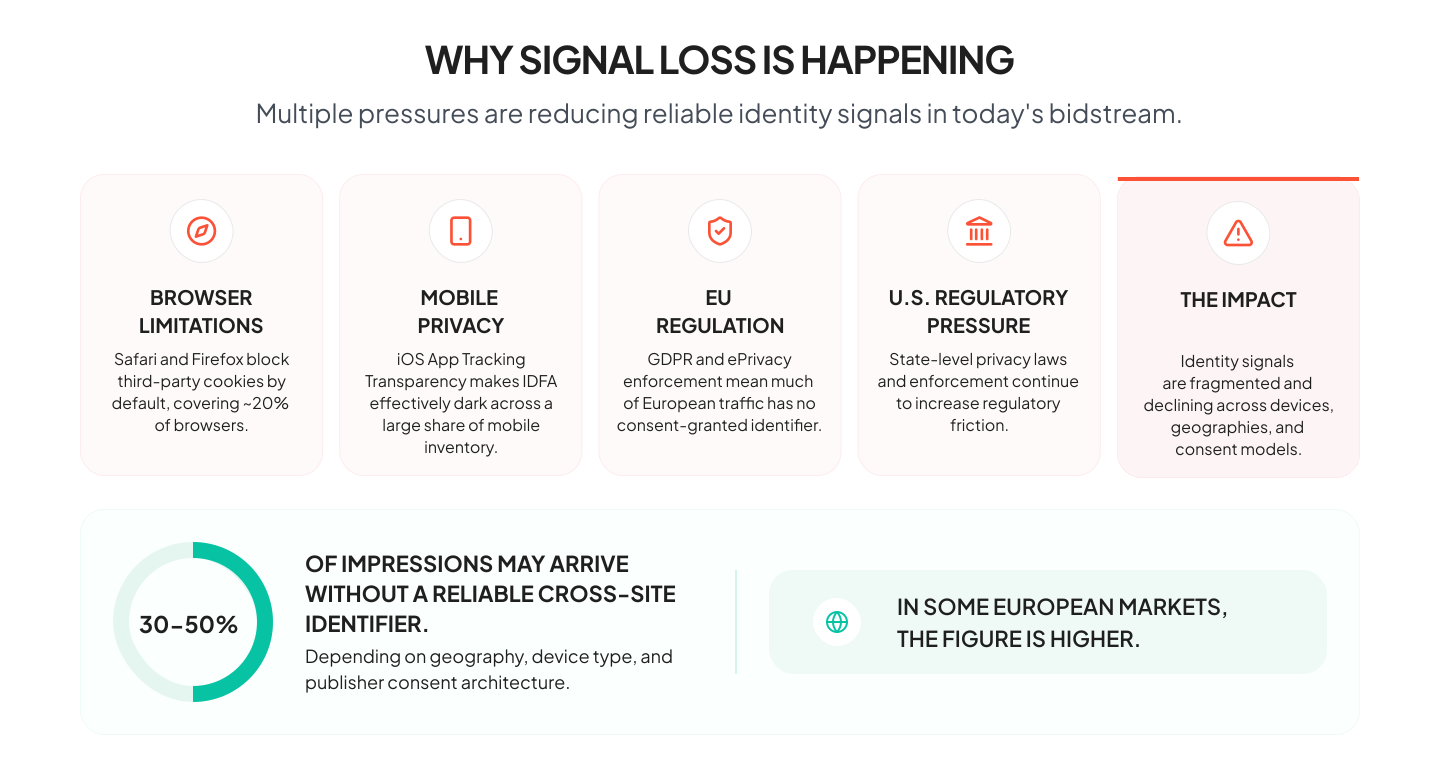
The real signal loss is happening through a different set of pressures. Safari and Firefox have blocked third-party cookies by default for years, collectively covering around 20% of browsers. iOS App Tracking Transparency has rendered the IDFA effectively dark across a substantial share of mobile inventory. GDPR and ePrivacy enforcement across the EU means that a significant portion of European traffic transacts without any consent-granted identifier. Regulatory friction is also tightening in the US at the state level.
The net effect is a bidstream where identity coverage is fragmented and declining, even if it hasn’t collapsed. Depending on geography, device type, and publisher consent architecture, anywhere from 30 to 50% of impressions may arrive without a reliable cross-site identifier. In some European markets, that figure is higher.
Legacy DSP bidding logic struggles here because it was architected around a stable user ID. When the identifier is absent, the model has no memory and falls back to inefficient floor-price bidding. Agentic AI addresses this by shifting the evaluation logic from identity resolution to signal-based intent inference across three alternative data layers:
Deep contextual ingestion. Rather than relying on who the user is, the agent evaluates where they are and what they’re engaging with. This means parsing the semantic structure and sentiment of the page, the content category, and real-time engagement signals at the moment of the bid request, not just keyword matching.
First-party data orchestration. CRM-derived signals can be connected directly to the bidder core via server-to-server integrations, hashed identifier matching, and clean room frameworks. This preserves addressability for known customers without any dependency on third-party middleware.
Cohort-based inference. For fully anonymous traffic, the agent bids on probabilistic cohorts derived from device type, time-of-day patterns, geo-signals, and behavioral proxies that correlate with conversion likelihood, rather than targeting a specific persistent ID.
This architecture is more resilient than cookie-dependent pipelines because its performance doesn’t cliff-edge when an identifier is missing. It degrades gracefully, shifting weight across available signal layers depending on what the bid request contains. It also carries lower regulatory risk, since the model values impressions based on contextual delivery context rather than cross-site tracking.
Budget Optimization and ROAS: Where AI Outperforms Human Traders
Human traders are limited by the averaging problem.
To manage a $100k+ monthly budget, a manual operator must aggregate data into segments, apply broad bid multipliers, and hope the historical average holds true for the next 24 hours. They bid on audiences. Agentic AI bids on events.
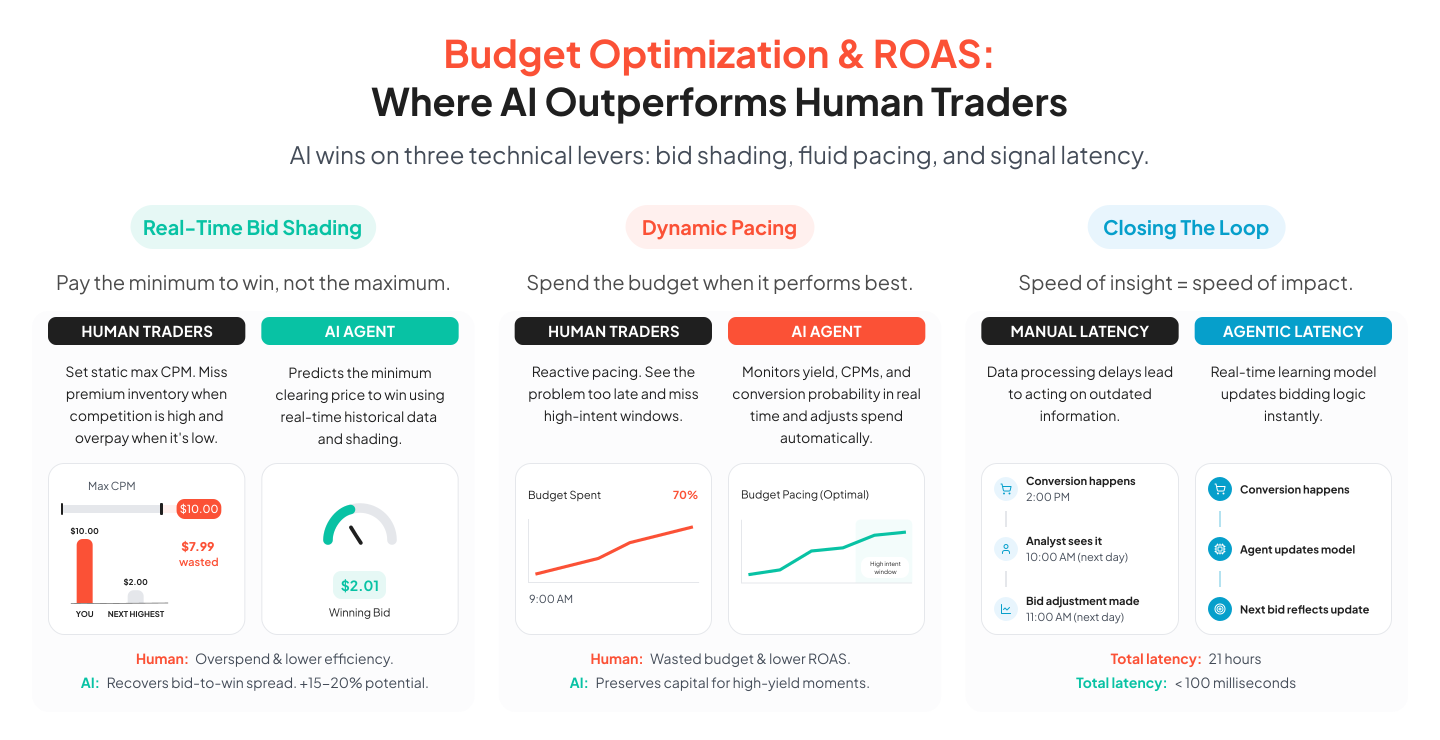
The performance gap between manual oversight and agentic orchestration comes down to three technical levers: bid shading, fluid pacing, and signal latency.
Real-Time Bid Shading
In a first-price auction environment, if you bid $10.00 and the next highest bidder is at $2.00, you pay $10.00. You’ve wasted $7.99 of capital on a single impression.
Human strategy: Traders set a static max CPM to prevent overspending. This causes them to miss premium inventory during high-competition windows and overpay during lulls.
Agentic execution: Artificial intelligence utilizes bid shading algorithms to predict the minimum clearing price required to win the auction. It audits the exchange’s historical clearing data in real time. Across millions of impressions, this recovery of bid-to-win spread can meaningfully increase effective media reach; some platforms report efficiency gains in the 15–20% range, without increasing overall spend.
Dynamic Pacing
Manual pacing is reactive. Traders check a dashboard at 9:00 AM and see that 70% of the budget was spent on low-quality early-morning traffic. They manually throttle the campaign for the rest of the day and miss the high-intent evening peak.
Agentic AI treats the daily budget as a fluid asset. It monitors the inventory yield. If the conversion probability drops or CPMs spike due to market volatility, the agent automatically decelerates spending.
It preserves capital for high-liquidity windows where the ROAS is mathematically proven to be higher. It solves the pacing bottleneck by calculating the optimal spend rate every millisecond, not every 24 hours.
Closing the Attribution-to-Bid Loop
The greatest drain on ROAS is integration debt. In a manual setup, a conversion happens at 2:00 PM, an analyst sees it at 10:00 AM the next day, and a bid adjustment is made at 11:00 AM.
Manual latency: 21 hours
Agentic latency: < 100 milliseconds
As soon as a conversion signal hits your data lake, the agent updates the weights in the bidding model. The very next bid request on the exchange reflects that new intelligence. You aren’t just automating a workflow. Instead, you are building a self-correcting financial engine that optimizes for ROAS at the speed of the bidstream.
AI Trends for Programmatic Advertising in 2026 and 2027
By 2027, the industry will move from integrated AI to embedded autonomy. We will observe a shift away from external API calls toward an architecture where AI agents reside directly within the exchange infrastructure.
Trend 1. The Rise of the Agentic Real-Time Framework
Latency has always been the enemy of sophisticated bidding. In the future, the Agentic Real-Time Framework will be the standard.
Instead of your DSP sending a request to an external model, you will deploy agentic containers co-located within the SSP’s hardware. This reduces the round-trip time (RTT) by up to 80%, allowing agents to perform multi-layer inference within the sub-100ms auction window.
Trend 2. Privacy via Zero-Knowledge Proofs (ZKP)
As third-party cookies become a legacy footnote, agentic AI will handle identity through Zero-Knowledge Proofs.
Agents will use cryptographic protocols to verify that a user belongs to a high-value segment without ever seeing or transferring PII (Personally Identifiable Information).
AI-powered programmatic advertising systems allow for high-precision targeting that is private by design. It means that they can satisfy strict global regulations while maintaining conversion performance.
Trend 3. Agentic Engine Optimization Bidding
The surface area of programmatic is expanding. The market is heading toward a world of Agentic Engine Optimization.
Brands won’t just bid for a banner on a webpage. They will bid for citation dominance within AI-generated summaries and conversational interfaces. As LLM-powered search and discovery tools capture a growing share of consumer attention, agentic DSPs will need to programmatically negotiate for brand presence within these surfaces, a fundamentally new inventory layer that sits outside the traditional display and video bidstream.
Trend 4. Multi-Agent Orchestration Ensembles
In the near future, we will move past the single-bidder model. Your future stack will likely be an ensemble of specialized agents. One agent handles traffic shaping (dropping worthless requests), another focuses on creative synthesis (generating ad variants on the fly), and a third manages capital allocation (fluidly shifting budget between CTV, social, and Open Web).
The result is a self-optimizing media engine that requires humans only for high-level governance and creative direction.
Ready to redefine your bidding strategy?
With 16+ years of experience in AdTech, our team will help you see how agentic AI can automate your specific bidding workflows.
Wrapping Up
When choosing AI-driven systems for programmatic advertising, many companies focus on improved ROAS. But it is not the only benefit that you can leverage. What is even more important is that agentic artificial intelligence clears up operational bottlenecks that stifle growth.
With AI programmatic advertising, you shift your team from traders to governors. As a result, you allow them to focus on high-level strategy while the machine handles the millisecond-level execution.
How does agentic artificial intelligence maintain performance in a cookieless bidstream?
Agentic AI replaces third-party cookies by analyzing high-dimensional signals like semantic page structure, real-time engagement metrics, and first-party CRM data. Instead of tracking a static ID, the agent bids on mathematical cohorts and intent patterns. Thanks to this, your ROI remains stable even as browsers deprecate traditional tracking methods.
Can agentic AI proactively defend against ad fraud?
Agentic systems mitigate fraud by identifying anomalous patterns in bid requests that humans often miss, such as high-velocity IP clusters or mismatched device headers. The agent can automatically block suspicious supply paths the moment they deviate from historical engagement baselines. This proactive filtering protects your budget from being drained by bot traffic before a human analyst ever sees the report.
What industries benefit most from AI programmatic advertising?
Sectors defined by high transaction velocity and perishable inventory (specifically e-commerce, travel, and financial services) gain the most from agentic orchestration. These industries utilize AI to synchronize real-time internal signals, such as fluctuating clearing prices, directly with the OpenRTB bidder. This prevents the integration debt and capital drain common in manual bidding environments.
Fill out the form below and we’ll get in touch within 24 hours
Software development expertise and senior tech talent for AdTech and Streaming Media projects.
Contact Us
Fill in the form
Thank you! We'll get in touch very soon.
Also you can book a call with our senior manager
We will be glad to see in our team!
Fill in the form
Thank you! We'll get in touch very soon.
Also you can book a call with our senior manager
Get a Free Consultation
Looking to build a successful custom software solution? Our experienced development team is ready to assist.
Thank you! We'll get in touch very soon.
Also you can book a call with our senior manager
Cookie Consent
We as well as our partners use cookies to enhance your browsing experience, analyze site traffic, and personalize content. For more details, see our Cookie Policy.
FunctionalAlways active
The technical storage or access is strictly necessary for the legitimate purpose of enabling the use of a specific service explicitly requested by the subscriber or user, or for the sole purpose of carrying out the transmission of a communication over an electronic communications network.
Preferences
The technical storage or access is necessary for the legitimate purpose of storing preferences that are not requested by the subscriber or user.
Statistics
The technical storage or access that is used exclusively for statistical purposes.The technical storage or access that is used exclusively for anonymous statistical purposes. Without a subpoena, voluntary compliance on the part of your Internet Service Provider, or additional records from a third party, information stored or retrieved for this purpose alone cannot usually be used to identify you.
Marketing
The technical storage or access is required to create user profiles to send advertising, or to track the user on a website or across several websites for similar marketing purposes.