Executive Summary:
- Infrastructure Matters: The gap between generic DSPs and CTV-first platforms has widened; success now requires high-concurrency bidding engines and deep SSAI integration.
- Identity over Cookies: Effective CTV DSPs must go beyond simple targeting to offer Household Identity (HHID) mapping and seamless Data Clean Room connectivity.
- The Feature Baseline: Beyond standard RTB, modern buyers prioritize SPO (Supply Path Optimization), cross-environment attribution, and predictive throttling to manage QPS costs.
- Strategic Choice: The “Buy vs. Build” decision rests on a partner’s domain depth, architectural scalability, and the ability to eliminate the “tech tax” through custom infrastructure.
For CTV advertisers seeking to maximize campaign performance and ROAS without compromising user experiences, the tech stack behind ad decisions makes a real difference. A functional and customizable demand-side platform (DSP) is at the heart of a winning advertising tech stack; it evaluates inventory in real-time and submits bids; while the SSP facilitates the auction, the DSP’s bidding engine determines the value of the impression based on advertiser-side data.
Yet, not all DSPs are equal. Choosing the wrong platform may leave significant revenue untapped, cause you to struggle with reporting fragmentation, and let your competitors win in terms of speed and innovation. The expanding roster of top-performing DSP platforms and development companies unlocks unprecedented technical opportunities:
- Direct-to-Publisher Pathing,
- Cross-environment Identity Resolution,
- High-Concurrency Bidding Architecture.
This way, the DSP selection is directly associated with campaign performance and monetization strategy.
This guide cuts through the noise, offering a condensed version of must-have DSP features for CTV advertisers. You will also find a detailed comparison of developers of the best DSP for CTV advertising needs to make informed choices aligned with your budget and business goals.
DSP as Demand-Side Infrastructure in the CTV Ecosystem
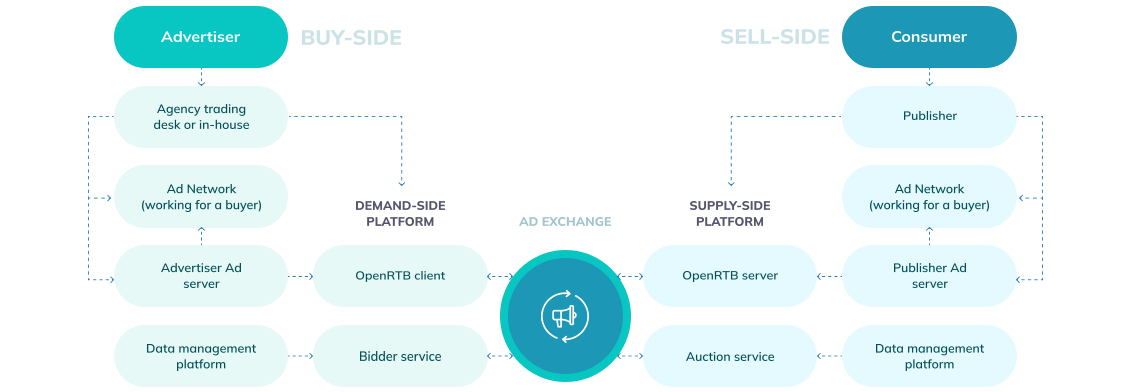
A demand-side platform (DSP) is a tech platform enabling programmatic purchases of digital advertising inventory in real time from multiple publishers. It links advertisers and agencies to multiple ad exchanges and supply sources.
DSPs for CTV bridge brands wishing to reach streaming audiences and premium inventory holders. Unlike the traditional TV advertising industry, CTV DSPs complete all purchases programmatically based on the pre-configured dataset.
When viewers launch streaming apps, and the content starts playing, a programmatic auction is triggered, with multiple advertisers bidding for that ad slot, activating Supply Path Optimization (SPO) and VPAID-free, SSAI-integrated unified auctions to minimize latency and maximize fill rates. Everything happens within milliseconds, with the winner assigned an ad slot based on the targeting criteria, budgeting parameters, and performance goals set for the specific advertising campaign.
DSPs serve as the primary demand channel for CTV advertisers. They aggregate buyer demand from thousands of advertisers, bridging them with relevant publishers who use SSPs (supply-side platforms) to fill their ad inventory at an optimal cost.
The process is executed automatically, without direct sales negotiations or manual procedures. Advanced DSPs also offer access to private marketplace (PMP) deals and programmatic guaranteed (PG) buying, increasing advertisers’ control over pricing and content.
In 2026, the shift toward Data Clean Rooms has become the gold standard. Leading DSPs now integrate directly with privacy-safe environments to allow brands to match their first-party CRM data with publisher audiences without exposing PII (Personally Identifiable Information).
Brands choosing CTV advertising tools must take into account the distinct features of purpose-built CTV DSPs, which can fine-tune ad inventory to the following specifics of CTV ad consumption:
- Support for 15/30-second non-skippable creatives and interactive overlays.
- Frequency capping across devices based on household graphs and identity providers.
- Deterministic Household Identity (HHID) mapping via unified graphs.
- Reliance on deterministic and probabilistic identifiers instead of cookies.
These nuances pose specific challenges for DSP CTV ad platform design and use, but brands that manage to overcome them reap the substantial benefit of direct household outreach.
DSP Place in Programmatic RTB Flow
Key Features of Top DSPs for CTV
Not all DSPs that claim to possess CTV capabilities are indeed able to deliver meaningful results of advertising in the streaming context. When evaluating DSPs, brands should pay close attention to the following core features:
- CTV Inventory Access. Best-in-class DSPs meant for CTV advertising must offer direct integration with major streaming platforms, smart TV manufacturers, and OTT content providers. The DSP’s breadth and quality of partnerships affect whether the ads will reach your target audience and how competitive they will be.
- SSAI & Seamless Ad Stitching. In the 2026 CTV landscape, user experience is non-negotiable. Top-tier DSPs must be fully compatible with Server-Side Ad Insertion (SSAI), which stitches ads directly into the video stream on the server side rather than the client side. This eliminates the “spinning wheel” or latency during ad breaks, bypasses standard ad blockers, and ensures a broadcast-quality transition between content and commercials. A DSP’s ability to handle SSAI-driven requests effectively is what differentiates a premium viewing experience from a fragmented one.
- Targeting Capabilities. Programmatic CTV is more precise in terms of audience targeting compared to traditional TV tools. Leaders in the DSP market can provide household-level targeting accuracy, automatic content recognition capabilities, lookalike modeling tools, and first-party data-backed ad inventory decisioning. These features work in tandem to increase the likelihood of reaching the right viewers instead of wasting ad budgets.
- Cross-Device Attribution. Modern tech-savvy users use CTV, mobile devices, desktops, and other gadgets on a regular basis, and DSPs should factor this fluidity into ad exposure calculations. To avoid irritating users with redundant ad repetitions, DSPs employ identity resolution techniques and outcome-based reporting that sheds light on user preferences and enables more accurate targeting.
- Brand Safety Tools. Premium CTV advertising is a high-value industry, making it a target of fraudsters. DSPs prevent fraud by using pre-bid filters, invalid traffic detection tools, and other brand safety shields that ensure that advertising budgets are spent on legitimate placements consistent with brand specifics.
- Reporting & Campaign Adjustment Tools. Real-time reporting is at the heart of efficient DSP use. Many brands adjust their campaigns dynamically based on incoming data to improve performance and maximize the value of money spent on advertising. That’s why clean UIs with client-friendly campaign setup and adjustment are a winning tandem for DSP selection.
- Furthermore, look for Predictive Throttling capabilities. In a high-QPS (Queries Per Second) environment like CTV, a DSP must intelligently filter out bids it is unlikely to win to save on infrastructure costs and improve listener efficiency.
When these features are in your checklist, choosing CTV advertising tools becomes a breeze. Now, it’s time to look at the companies that meet these criteria and can deliver an indeed powerful CTV ad platform for competitive business outreach.
The 2026 CTV DSP Landscape: Buy vs. Build
Before choosing a development partner, it is essential to understand where the market’s “gravity” lies. The CTV ecosystem is currently split between two types of players:
1. Managed Platforms and Walled Gardens (The “Buy” Option).
These are established platforms that offer immediate access to inventory but often come with “black box” algorithms and high take rates.
- The Trade Desk (TTD): The leading independent DSP. In 2026, its OpenPath initiative and UID2 identity framework make it the gold standard for reaching the “Open Internet” outside of Google and Amazon.
- Google DV360: The powerhouse for cross-channel integration. It remains the only way to access YouTube CTV inventory with granular Google search-intent data.
- Amazon DSP: Essential for performance advertisers. It leverages unmatched first-party purchase data and offers exclusive access to Prime Video, Freevee, and Fire TV inventory.
- Roku (OneView): A vertically integrated giant. Because Roku owns the hardware, its DSP provides unique automatic content recognition (ACR) data from over 100M+ streaming households.
2. Custom DSP Infrastructure (The “Build” Option).
While the platforms above are powerful, many sophisticated AdTech firms, large agencies, and retail media networks are now choosing to build their own proprietary DSPs. This is where development partners like Geomotiv or Xenoss come in.
Why choose a custom build over TTD or DV360?
- Zero Tech Tax: Avoid the 15–30% platform fees charged by major DSPs.
- Algorithm Ownership: Build your own custom bidding logic (e.g., bidding based on real-time weather or specific retail stock levels).
- Data Sovereignty: Ensure your sensitive first-party data never leaves your own VPC (Virtual Private Cloud).
Best Demand-Side Platform Development Companies for CTV in 2026
For companies that have outgrown the ‘standard’ features of TTD or DV360, the following development partners offer the specialized engineering required to build a proprietary, high-load CTV bidding engine:
- Geomotiv.
- Asteriosoft.
- Intellias.
- Avenga.
- Xenoss.
- Innowise.
Let’s see which one is worth your time and what you should expect from a partnership.
Geomotiv
Geomotiv is a US-based DSP software development company established in 2010, with headquarters in Alexandria, VA. The company’s team exceeds 200 capable software engineers and developers, specializing in programmatic advertising solutions. Their service range spans AdTech, MarTech, OTT/CTV, retail media, and e-commerce solutions. Their client roster includes Rubicon Project, Pluto TV, MediaMath, and Adform.
Geomotiv’s DSP CTV service package is internationally competitive because of the team’s in-depth experience in OTT TV and CTV advertising platform development. Geomotiv’s experts can add the necessary integration layers on demand and establish the client DSP’s connectivity with direct, programmatic, and third-party supply and demand sources. DSP solutions by Geomotiv offer numerous business advantages, including:
- Programmatic optimization of CTV DSP products.
- Big Data analytics for improved ad serving.
- Automated media buying and selling transactions based on AI-powered audience segmentation.
- Deep inventory integration expertise
- AI/ML-powered bidding and campaign tuning capabilities.
Geomotiv’s vast expertise in full-stack AdTech platform development makes it a reliable partner for businesses of all scales and sizes. Their CTV DSP cases illustrate a 3x revenue increase across projects, which suggests tangible business value within reasonable timeframes.
Asteriosoft
Asteriosoft was founded in 2006, with headquarters in Budva, Montenegro. This AdTech software development company also delivers robust real-time analytics solutions. Its primary industries of interest include advertising tech, MarTech, and FinTech. The company claims to have built a thoroughly vetted team of experts capable of delivering expertise, continuity, and business value.
CTV advertisers may enjoy working with Asteriosoft because of its in-depth niche expertise: the company offers AsterioDSP, a ready-to-deploy DSP solution for rapid market entry. It is also behind the RhythmOne AdServer design and deployment in the USA. AsterioDSP offers:
- Multi-format ad support, including banners, native ads, video, display, and CTV ads.
- Ad inventory adjustments based on CTR, CVR, and CPA parameters.
- An effective anti-fraud system that performs double verification of impressions, clicks, and events.
- Third-party integrations for ad serving and fraud prevention activities.
The benefits of Asteriosoft’s DSP product range from rapid deployment timelines to real-time analytical depth and ML-powered optimization. These features make it optimal for fast, scalable CTV-ready DSP launches in the fast-moving, competitive market.
Intellias
Founded in 2002, Intellias offers over two decades of tech experience. The company is headquartered in Lviv, Ukraine, and has several regional offices in Poland, Croatia, Portugal, and India. The total team of Intellias exceeds 3,000 experts, dispersed across its multiple locations. The company boasts a huge portfolio of 450+ completed projects spanning software engineering and digital consultancy.
The company specializes in superior AdTech software design. It can create a DSP from scratch or optimize an existing software product with new features and functions. Intellias’s experts also integrate DSPs with broader advertising networks, including ad servers, ad exchanges, and SSPs. CTV advertisers can take advantage of the following services:
- Data consolidation from multiple sources.
- Comprehensive traffic and audience segmentation.
- Data processing integrations for real-time decision-making.
- Advanced analytics of existing DSP capabilities.
Avenga
Avenga emerged in the international software development market in 2019 as a result of several tech companies’ mergers. It brought the Polish Kontrakt, the German Sevenval, and the Ukrainian-American partnership Corevalue under one roof. As of 2026, this company is headquartered in Cologne, Germany, and has over 5,000 staff across five continents, where it has regional offices. Avenga provides software solutions to clients in the insurance, finance, automotive, pharmacology, and technology sectors. One of its service verticals is AdTech, with feature-rich product options for CTV advertisers.
Avenga’s DSP products unlock precise media buying activities at scale, with impression-level control and advanced targeting capabilities. Its branded software unlocks unrivalled ad spend control and performance optimization improvements, which contribute to high campaign efficiency. All software products target intelligent automation and real-time campaign adjustment.
Clients often choose Avenga because of its service scale and full-service consultancy services, giving access to its team’s first-hand expertise and nuanced understanding of the AdTech landscape.
Xenoss
Xenoss is a Brooklyn-headquartered business with more than a decade of track record in the AdTech market. Founded in 2013, it is the brainchild of AdTech veterans working in the industry since the early 2000s. The company employs fewer than 100 staff, offering a truly boutique experience to clients seeking customized AdTech solutions. Its clients include Activision Blizzard, Sizmek, Voodoo, and Dataseat, among others. Xenoss is also known as a software developer for such industry giants as Nestle, Adidas, and Uber.
Xenoss’s AdTech services are diverse, including DSPs, SSPs, DMPs, and ad exchanges of varying levels of complexity. It offers CTV and OTT advertising platforms, programmatic DOOH, and fraud detection tools for publishers and advertisers.
The brand’s low-code DSP development framework speeds up deployment by minimizing development work with a large set of pre-built components. Thus, businesses choose Xenoss for building and scaling CTV DSPs with the help of preconfigured AdTech environments.
Innowise
Innowise was founded in Frankfurt am Main, Germany, in 2007, where its headquarters are still located. The company has a broad international presence, with offices in multiple countries, including the USA, and a skilled tech team of 2,000+ experts. It is a full-cycle software development company with a portfolio of 850+ projects and a client base exceeding 200 businesses across Europe and the USA.
Brands seeking superior DSP development experience can benefit from Innowise’s full-cycle delivery model, from in-depth analysis of business requirements to AdTech platform design and deployment. The provider also delivers long-term support, offering its tech expertise in high-load system maintenance, cloud solutions, and Big Data.
Company profile
| Geomotiv | Asteriosoft | Intellias | Avenga | Xenoss | Innowise |
|---|
| Founded | 2010 | 2006 | 2002 | 2019 | 2013 | 2007 |
| HQ | Alexandria, VA, USA | Budva, Montenegro | Lviv, Ukraine | Cologne, Germany | Brooklyn, NY, USA | Frankfurt, Germany |
| Team size | ~200 | ~15-20 | 3,000+ | 5,000+ | ~85 | 2,000+ |
| Company type | Dev partner | Dev partner | Dev partner | Dev partner | Dev partner | Dev partner |
CTV & OTT focus
| Geomotiv | Asteriosoft | Intellias | Avenga | Xenoss | Innowise |
|---|
| CTV/OTT native expertise | Yes
Core vertical | Partial
Via custom DSP builds | Yes
OTT/CTV dev services | Yes
CTV, OTT, in-game, DOOH | Yes
CTV/OTT platforms | Partial
General AdTech coverage |
| Custom DSP development | Yes | Yes
Incl. ready-to-deploy AsterioDSP | Yes | Yes | Yes
Proprietary AdTech framework | Yes |
| Off-the-shelf / white-label DSP | Partial
Via Adoppler spinoff | Yes
AsterioDSP (2-week deploy) | No
Custom builds only | No
Custom builds only | Partial
Low-code framework speeds delivery | No
Custom builds only |
Key DSP features for CTV publishers
| Geomotiv | Asteriosoft | Intellias | Avenga | Xenoss | Innowise |
|---|
| Real-time bidding (RTB) | Yes | Yes
Up to 1.5M QPS | Yes | Yes | Yes
AI/ML-enhanced bidding | Yes |
| PMP / programmatic guaranteed | Yes | Yes | Yes | Yes | Yes | Partial |
| Audience targeting & segmentation | Yes
Big Data & AI-driven | Yes
ML conversion prediction | Yes
Multi-source data consolidation | Yes
Impression-level targeting | Yes
AI/ML audience models | Yes |
| Household-level targeting | Full (via Identity Graph Integration) | Partial | Partial | Partial | Full (via Identity Graph Integration) | Partial |
| First-party data integration | Yes | Yes | Yes | Yes | Yes | Yes |
| Ad fraud detection | Yes | Yes
Double verification system | Yes | Yes | Yes
Dedicated fraud prevention | Yes |
Analytics & measurement
| Geomotiv | Asteriosoft | Intellias | Avenga | Xenoss | Innowise |
|---|
| Real-time reporting & dashboards | Yes | Yes
Core specialty | Yes | Yes | Yes | Yes |
| Cross-screen attribution | Yes | Partial | Yes | Yes | Yes | Partial |
| Outcome-based measurement | Partial | Partial | Partial | Partial | Partial | Partial |
Technology & integration
| Geomotiv | Asteriosoft | Intellias | Avenga | Xenoss | Innowise |
|---|
| AI / ML optimization | Yes
AI-driven ad serving | Yes
ML models, cookieless DSP | Yes
AI-powered RTB | Yes
AI/ML for DSP & SSP | Yes
AI/data engineering core | Yes |
| SSP / ad exchange integration | Yes
Full-stack AdTech builds | Yes
30+ SSP integrations | Yes | Yes | Yes | Yes |
| DMP / CDP integration | Yes | Partial | Yes | Yes | Yes | Yes |
| Cookieless / privacy-ready | Partial | Yes
Contextual cookieless DSP | Partial | Partial | Partial | Partial |
| Scalability / high-load architecture | Yes | Yes
Millions of req/sec | Yes | Yes | Yes
High-load systems core | Yes
Cloud & microservices |
Service model
| Geomotiv | Asteriosoft | Intellias | Avenga | Xenoss | Innowise |
|---|
| Full-cycle development | Yes | Yes | Yes | Yes | Yes | Yes |
| DSP modernization / upgrades | Yes | Yes | Yes
Incl. software audits | Yes | Yes | Yes |
| Staff augmentation | Yes
Core offering + dedicated team extension | Partial | Yes | Yes | Yes
Dedicated team extension | Yes |
| AdTech consulting | Yes | Partial | Yes | Yes | Yes
Tech & cloud consulting | Yes |
| Best suited for | Advertisers and publishers building or scaling OTT/CTV AdTech | Teams needing fast DSP deployment with proven RTB engine | Enterprises modernizing or building large-scale programmatic stacks | Global publishers needing end-to-end AdTech + MarTech strategy | Startups & scaleups needing deep AdTech IP with fast delivery | Mid-large publishers needing full-cycle dev across a broad tech stack |
How to Choose the Right CTV DSP for Your Business
In line with the features discussed above and the top players of the present-day market, you may focus on the core benefits of a DSP developer today:
- Domain depth: While there are many excellent AdTech software developers, not all of them specialize in CTV advertising. Thus, by choosing a company with in-depth CTV expertise, you get a partner that can make correct architectural decisions reflected in RTB mechanics, floor pricing, and auction dynamics working in the CTV environment.
- Scalability: The chosen platform should be designed to handle millions of bid requests per second without degradation.
- Integration breadth: The chosen platform should give easy access to leading SSPs, ad exchanges, DMPs, and data analytics providers to let your DSP plug into the broader ecosystem of digital advertising without friction.
Conclusion
The CTV advertising market is growing fast, with infrastructural decisions making a real difference. DSP selection is a high-stakes process that affects your ad campaigns’ key outcomes. The choice of options is rather broad, from boutique development agencies like Geomotiv, Asteriosoft, and Xenoss to large-scale consultancies like Intellias and Avenga. Use the list presented above, as well as a checklist with core features, to make informed choices that will drive your business forward and increase your outreach via CTV advertising.