Top AdTech Tools Every Marketer Should Know in 2026

Top AdTech Tools Every Marketer Should Know in 2026
Table Of Contents:

In 2026, AdTech is no longer just infrastructure, it is the operating system of digital advertising. As automation deepens, identity signals fragment, and CTV spending accelerates, marketers rely on advanced AdTech tools to control targeting, measurement, and supply chain transparency at scale.

Here is a detailed breakdown of the best AdTech tools every marketer should take advantage of in 2026.

What are AdTech Tools

Some of them are AI-powered, ensuring a high level of automation and vast customer outreach without manual operation. Technical functions of AdTech tools include impression-level transactions, customer targeting and segmentation, ad delivery, and performance measurement in real-time. Modern AdTech solutions also target fraud prevention and ad space sales with proper regard to the supply chain transparency requirements of partnering companies.

Core Categories of AdTech Tools

The diversity of AdTech tools is determined by functional differences and practical goals that specific platforms and software address. Here are the main categories that should be in every marketer’s 2026 toolkit.

Demand-Side Platforms (DSPs)

A DSP is a bidding engine working on the ad buyer’s side, enabling individual advertisers and agencies to purchase ad impressions with the help of programmatic software. Modern AI-powered DSPs give access to multiple ad exchanges and SSPs through a real-time bidding (RTB) feature. AdTech tools examples in this category include The Trade Desk and Amazon DSP.

Supply-Side Platforms (SSPs)

SSPs work on the publisher’s side and help ad space sellers maximize yields from available ad space. This way, an SSP is a monetization platform that performs the full lifecycle of ad inventory management, from packaging to sales. Modern SSP platforms also utilize AI to integrate fraud and brand safety controls to help publishers avoid reputational risks of programmatic ad space allocation via auctions. The best-known SSP examples are OpenX and Magnite.

Ad Exchanges

An ad exchange is a neutral intermediary where multiple SSPs and DSPs meet, and their clients participate in ad space auctions in real time. Those who access ad exchanges on the SSP side generate bid requests by publishing an ad space slot, and the exchange automatically sends out a request to all linked DSPs. The bids are submitted programmatically, and the ad exchange awards the ad space to the winning bidder. AI makes all processes ultra-fast and precise.

Ad exchanges work as open auctions via RTB mechanics, private marketplaces, and programmatic guaranteed auctions. They guarantee liquidity and competition among companies in the digital advertising sales and operate using standardized protocols to ensure transparency and fair price competition. Some examples include Google AdX, PubMatic, and Xandr.

Ad Servers

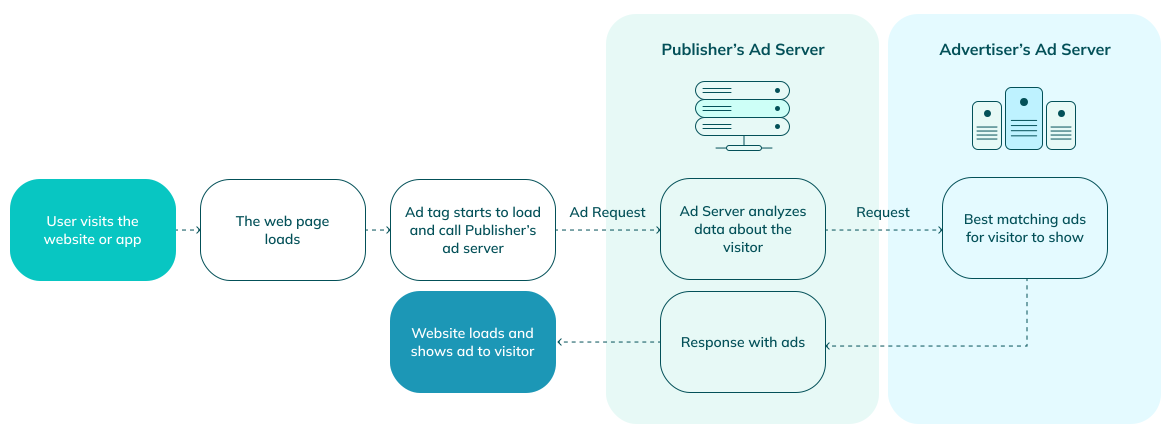
Ad Server scheme

The ad server component is an operational layer in the process of programmatic ad space sales between companies. Ad servers host creative assets and execute their delivery and performance tracking.

Digital advertisers can use ad servers of two types:

  • Third-party ad servers perform the functions of creative asset hosting, impression and click tracking and conversion attribution, thus serving the buyer’s goals of outcome measurement across advertising platforms.
  • First-party ad servers act as decision engines for inventory, thus striking the right balance between direct deals and programmatic demand to maximize the publisher’s yield.

The best-known ad server is Google Ad Manager.

Data Management Platforms (DMPs)

DMPs are not directly involved in the execution of programmatic ad space sales, but they inform the DSP-side decisions. Modern DSPs utilize AI to aggregate and analyze massive audience data to activate specific media buying campaigns. They compile data from first-party sources, like CRM and site behavior statistics, with partner data and third-party data brokers to perform behavioral modeling and identity resolution. Based on these analytical insights, DMPs create audience taxonomies that inform targeted ad space buying via DSPs.

Though DMPs are highly valuable and informative in the AdTech space, they have a significant limitation that an advertising company should be aware of. They are still cookie-dependent, which limits the accuracy of customer segmentation in the post-cookie advertising space. This is the reason they are often replaced by CMPs (discussed further). Popular DMP examples are Lotame, Adobe Audience Manager, and Oracle BlueKai.

How AdTech Platforms Work Together
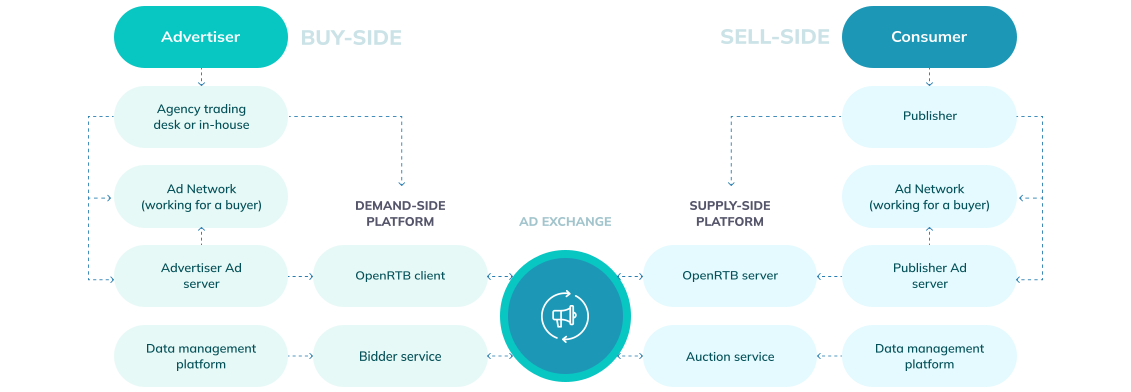
OpenRTB integration scheme

Creative Management Platforms (CMPs)

CMPs address the DMP limitation by offering dynamic creative optimization, which involves real-time ad assembly (headline, CTA, image, and background) based on customer profile and context. The CMP also takes into account core performance signals, with bulk generation of creative variants from structured feeds. AI-powered CMPs enable multivariate ad testing and inform continuous ad adjustments based on the DSP reports on the most successful combinations. This way, the use of CMPs reduces creative production costs for companies, fuels unrivaled ad personalization, and improves the CTR and CVR metrics of ad sales. A notable CMP example is Nexd.

Note: In some contexts, CMP refers to Consent Management Platforms; here we refer to Creative Management Platforms used for dynamic creative optimization.

What’s Changing in AdTech in 2026

Three structural shifts are redefining tool selection:

  • CTV and Retail Media expansion require platforms that support household-level targeting and closed-loop attribution.
  • AI-powered bidding and creative optimization are becoming default expectations, not differentiators.
  • Privacy-first ecosystems limit deterministic IDs, pushing contextual, first-party, and modeled targeting strategies.

Specialized AdTech Tools and Solutions

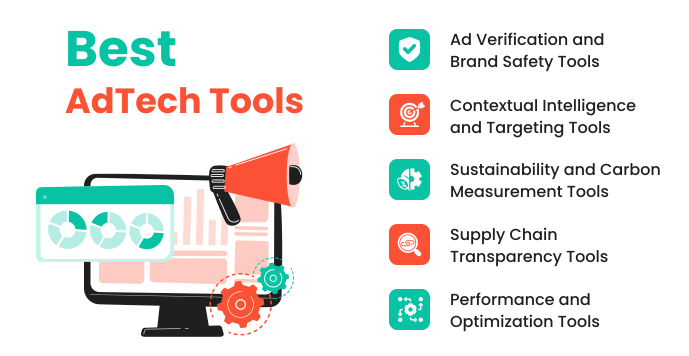
Besides the core AdTech stack required to make programmatic ad sales possible, the industry offers specialized tools that improve outcomes and oversee the quality and transparency of all processes. Here is a list of the best AdTech tools serving these goals.

learn Best Adtech Tools

Ad Verification and Brand Safety Tools

Bots and fraudsters dominate the online space, undermining the outcomes of digital advertising efforts and making some of them openly risky and illegal for companies. Ad verification and brand safety tools ensure that advertising budgets aren’t wasted in vain, reaching real humans in contextually relevant environments. They work as follows:

  • Pre-bid filtering based on the website’s reputation, historical invalid traffic (IVT) pattern analysis, content categories it covers, and the context on the web page. The level of risk is evaluated based on this data, with high-risk impressions blocked before bid placement.
  • Post-bid verification serves additional validation goals. Safety tools detect IVT, check device consistency, and validate geolocation to verify that the ad was actually delivered where it had been promised to.

One of the popular examples of such brand safety tools is Sincera, a solution that reduces fraud exposure for companies and improves confidence in ad inventory quality. It evaluates publishers and maps ad supply to help media buyers avoid risky ad placements.

Contextual Intelligence and Targeting Tools

In times of reducing cookie availability, advertisers are in search of alternative sources of data for accurate targeting. Contextual intelligence and targeting tools like GumGum and Silverpush help ad buyers target relevant environments without user-level identifiers. They parse page texts and metadata to classify meaning and develop a nuanced semantic understanding for ad space suitability analysis. The result of their analysis is fed into DSPs as deal IDs, giving media buyers more contextual understanding that guides bidding logic.

Sustainability and Carbon Measurement Tools

Digital advertising is energy-consuming, and carbon emission targets are real. In many jurisdictions, such as the EU, they translate into tangible legal restrictions and sustainable advertising goals mandatory for compliance. Sustainability and carbon measurement AdTech tools help industry participants to quantify and reduce their advertising carbon footprint by avoiding high-emission inventory paths. This way, low-emission media get prioritized in the RTB process, with advertisers meeting their sustainability goals without ad quality compromises.

An illustrative example of these tools’ work in practice is Scope3. The solution measures ad campaign emissions based on auction overheads, energy consumption during data transfer, device types involved, file size of creative assets, and the number of intermediaries. Scope3’s emissions estimates help businesses reduce their advertising carbon footprint and can be used to enforce “carbon-aware” ad buying practices.

Supply Chain Transparency Tools

Digital advertising pathways are becoming increasingly complex, which often disguises the final endpoint of ad space buying activities. Supply chain transparency tools help ad buyers verify whether their counterparties are authorized to sell ad inventory and avoid risky intermediaries. Tools like Sellers.guide validate ad sellers and perform in-depth supply path analysis and enforcement by labelling publishers and sellers as either preferred or blocked. Sincera is also a popular tool for risk pattern identification.

Performance and Optimization Tools

Every advertiser strives to maximize the outcomes of their ad campaign spend. The core parameters used to assess advertising results include CTR/CVR, viewability, latency, and revenue yield. Optimal metrics are attainable only if advertisers identify bottlenecks and tune delivery parameters to their targets (e.g., creative weight or header bidding configuration).

Performance and optimization tools collect performance signals and offer comprehensive diagnostics based on the available data. They provide advice on the sources of ad campaign inefficiency and issue recommendations for web page performance improvement.

How AdTech Tools Work Together: The Programmatic Ecosystem

While each of the AdTech tools discussed serves specific goals, in most cases, the programmatic AdTech ecosystem is created to integrate all components of ad sales. As a rule, the complete ad selling pipeline requires the following stack:

  1. As soon as potential customers load web pages, the SSP packages an impression and sends a bid request to the ad exchange.
  2. The exchange distributes the bid request across connected DSPs, who evaluate the customer and campaign logic and bid for the ad space.
  3. The winning bid is selected, with the ad server delivering the creative asset.
  4. DMPs/CMPs work in tandem with other AdTech tools to optimize ad space selection and bidding for better participant outcomes.

In practice, advanced advertisers increasingly collapse these layers into vertically integrated stacks to reduce latency, fees, carbon overhead, and dependency on third-party intermediaries.

Choosing AdTech Tools: Key Considerations

The AdTech market may seem overwhelming, with many companies offering robust tech tools that serve a variety of goals. Here is a checklist that may guide a marketer’s decision-making process:

  • Business objectives. Every brand has specific KPIs for its advertising campaigns. While some prioritize CPA and ROAS, others target brand safety compliance and consumer attention. Thus, AdTech tools should be selected based on specific strengths, e.g., prospecting, retargeting, or CTV reach.
  • Identity constraints. Every company should take a closer look at the IDs that the AdTech tool uses to make automated decisions. Some advertising environments come with limited IDs, and AdTech tools should be able to perform well there.
  • Transparency and controllability. Many brands wish to enjoy a high level of control over logs, which informs business analysis. Others prioritize supply path transparency and want to use explainable AI models instead of black-box AI logic.
  • Brand safety. Every company is primarily interested in reducing reputational risks, which is possible with the help of sophisticated IVT analytics and suitability controls.
  • Financials. The commercial side of AdTech is also decisive for many brands and companies. Platform use fees, take-rate, and data fees add up to increase advertising costs. That’s why software products with transparent pricing are given priority in the AdTech market.
Designing a Future-Proof AdTech Stack?

Off-the-shelf tools rarely align perfectly with your revenue model, targeting logic, or transparency requirements. Work with AdTech engineers who design scalable, AI-driven ecosystems built around your business goals.

Conclusion

In 2026, competitive advantage in digital advertising depends on how well your AdTech stack integrates bidding intelligence, creative optimization, transparency controls, and privacy resilience. The right tools don’t just automate campaigns, they shape revenue outcomes.

As CTV scales, retail media expands, and privacy constraints tighten, fragmented stacks create inefficiencies, hidden fees, and lost signal value. Forward-looking advertisers and publishers increasingly move toward tailored, vertically integrated AdTech infrastructures designed around their revenue models.

The right AdTech tools don’t just automate campaigns, they shape margins, transparency, scalability, and long-term growth.

If your stack wasn’t designed intentionally, it’s likely costing you more than you think.

Need Help? We’ve Got You Covered!

Why are AdTech tools so important for businesses?

AdTech is a market segment of automated, AI-powered solutions that streamline all operations with ad inventory. They power programmatic advertising at scale without reputational risks or invalid content to deliver optimal outcomes to advertisers and ad space sellers.

How do modern AdTech tools handle privacy and the decline of third-party cookies?

Advertisers increasingly rely on first-party data collected through CRM and CDP integrations, as well as contextual targeting and identity frameworks. Modern solutions are designed specifically for environments with limited deterministic identifiers for the sake of meeting strict privacy compliance rules.

How can advertisers evaluate the AdTech tool’s effectiveness?

Genuine effectiveness parameters often go beyond the brand’s official metrics. Companies choosing AdTech tools should pay attention to incrementality testing, log-level transparency, fraud controls, and supply path quality as important indicators.

Recommended Reading

Let Us Contact You

Fill out the form below and we’ll get in touch within 24 hours

    contact us2
    Software development expertise and senior tech talent for AdTech and Streaming Media projects.