Ad Network vs DSP: Which Advertising Solution is Right for Your Business Model

Ad Network vs DSP: Which Advertising Solution is Right for Your Business Model
Table Of Contents:

Choosing between an ad network vs DSP isn’t just a tooling decision, it’s a control decision.

One option simplifies buying through packaged inventory and managed workflows. The other gives advertisers granular, impression-level control across exchanges and supply paths.

As programmatic advertising becomes more transparent, privacy-regulated, and AI-driven, the structural differences between ad networks and DSPs have strategic implications for cost efficiency, targeting precision, and long-term scalability.

This guide breaks down those differences to help you determine which model fits your business architecture.

What is an Ad Network?

Unlike DSPs, advertisers buying through ad networks usually do not participate directly in real-time auctions. Instead, the network bundles inventory, applies its own pricing structure, and delivers campaigns either through self-service dashboards or managed service models.

In many cases, ad networks operate as inventory resellers, sometimes purchasing impressions programmatically and repackaging them for simplified advertiser access.

Ad networks work as follows:

  1. Ad inventory is collected across publishers registered in the network.
  2. The ad network algorithm sorts and categorizes ad space based on audience, format, pricing, and other core characteristics.
  3. The network analyzes advertiser demand and matches suitable ad space slots.
  4. The platform also serves ads automatically or via managed service and handles all reporting.

The main characteristics distinguishing ad networks from other AdTech software solutions include:

  • Aggregation-first logic, which presupposes a compilation of ad inventory from multiple publishers into one bundle.
  • Simplified buying pipeline mimicking that of a traditional marketplace.
  • Managed options, which buyers can choose alongside self-service.
  • Vertical specialization variants for media buyers looking for video-only, mobile, gaming, or other ad inventory segments.

What is a DSP?

DSPs connect to multiple publishers, supply-side platforms (SSPs), and ad exchanges in real time to locate the best ad space slots matching the company’s needs. At the heart of DSP work is the real-time bidding (RTB) logic, which makes the process of ad space allocation fully automated.

Here’s how DSPs work in practice:

  1. Users visit websites and apps.
  2. Inventory becomes available on the SSP or ad exchange.
  3. DSPs evaluate the inventory’s characteristics and decide on bidding.
  4. Winning bids are served.
  5. Performance data is fed back into the DSP to inform campaign evaluation.

The entire process happens within milliseconds, which is unattainable via manual ad space allocation. DSPs’ core features include:

  • Programming buying engine: the RTB mechanism automates the entire process based on the advertiser’s specific settings and preferences.
  • Access to multiple ad inventory sources: Advertisers get wide access to different publishers via one DSP.
  • Advanced targeting filters: Top-tier DSPs enable audience, contextual, behavioral, geolocation-based, and device-specific audience targeting.
  • Bid and budget control: Advertisers retain high control over pricing, frequency, and pacing of their ad inventory.
  • Ad performance measurement and optimization: DSPs provide ad performance reports in real time and allow dynamic campaign tuning.

Ad Network vs DSP: Key Differences

When advertisers are choosing between ad networks and DSPs, they have to take multiple criteria into account, from these AdTech types’ roles to use cases and buying models involved. These solutions also differ in terms of control level, cost, transparency, and targeting accuracy, so the choice should be informed by business-specific goals and expectations. Here is a comparative breakdown of ad networks vs. DSPs that can inform your selection.

CriteriaAd NetworkDSP (Demand-Side Platform)
Primary roleAggregates publisher inventory and sells it to advertisersPlatform for advertisers to buy inventory programmatically across exchanges/SSPs
Who typically uses itSMB advertisers, app marketers, publishers, agencies needing simple buyingPerformance marketers, agencies, brands with in-house programmatic teams
Buying modelUsually packaged inventory buying (sometimes managed)Real-time bidding (RTB) and automated impression-level buying
Level of controlMedium to low (depends on network)High (bids, targeting, frequency, pacing, supply paths, etc.)
Inventory accessInventory available within that network’s ecosystem/partnersInventory across multiple exchanges, SSPs, and publisher sources
TransparencyOften limited (less visibility into exact placements/impression paths)Higher transparency (placement, auction, pricing, performance-level reporting)
Targeting optionsBasic to moderate targeting (geo, device, audience segments, etc.)Advanced targeting (first-/third-party audiences, contextual, retargeting, lookalikes, etc.)
OptimizationNetwork-managed or simplified optimizationAdvertiser-controlled optimization with granular rules and algorithms
Ease of useEasier to launch, lower learning curveMore complex setup and ongoing management
Technical expertise requiredLowHigh
Speed to launchFastModerate (setup, tracking, data integration, strategy needed)
Reporting depthStandard campaign reportsDeep analytics, bid-level and audience-level optimization insights
Pricing controlLess flexible; pricing often packaged or semi-managedStrong control over bids, budgets, pacing, and CPA/ROAS strategy

Targeting and Audience Data: Where DSPs Pull Ahead

One of the most important differences between ad networks and DSPs lies in how targeting decisions are executed.

Ad networks typically sell packaged inventory or predefined audience segments. While this simplifies campaign setup and accelerates scale, it limits impression-level control and reduces visibility into individual bid dynamics.

DSPs, by contrast, evaluate each impression in real time. The buying engine analyzes user signals, contextual data, device attributes, prior exposure, and bid price before deciding whether to participate in the auction.

This impression-level decisioning enables advertisers to apply granular targeting rules, frequency caps, and bid strategies aligned with conversion probability rather than relying on pre-bundled segments.

At a technical level, a DSP evaluates:

  • User or identifier signals (where available).
  • Device and environment attributes.
  • Page or app context.
  • Historical exposure and frequency data.
  • Retargeting eligibility.
  • Estimated conversion likelihood at the current auction price.

Only if the impression meets predefined performance and pricing criteria does the DSP submit a bid.

This selective participation model increases efficiency, improves return on ad spend, and gives advertisers greater control compared to packaged inventory buying.

ad networks vs dsps_Targeting and Audience Data: Where DSPs Pull Ahead

Cost, Pricing Models, and Hidden Fees Compared

Many companies focus on the cost of AdTech as a core decision-making criterion, but it is not always the best way to go. At first glance, ad networks seem to be much more affordable solutions because their pricing models are more transparent. A typical pricing structure follows a bundled pricing model and looks as follows:

  • CPM (cost per 1,000 impressions).
  • CPC (cost per click).
  • CPA/CPI (cost per acquisition or install).

Flat-rate prices and managed buys are also available on some ad networks, with one common trait in all pricing approaches: the cost of media and the network’s margin are bundled into a single price. Such an arrangement is definitely more convenient for media buyers because ad network campaigns are easier to budget, with fewer variables to manage. However, this approach disguises the true cost of media versus network markup, making it hard for the advertiser to understand how much they really pay for ad space.

DSPs usually come with more complex price-setting, with components including:

  • Media spend (the auction-clearing cost of every ad impression).
  • DSP use fee (percentage of media spend).
  • Data fees (cost of audience segmentation and third-party data access).
  • Ad serving and creative fees (optional).
  • Measurement and verification fees (extra fraud detection and viewability tools).
  • Managed service cost (the cost of hiring an agency or trading desk to manage ad campaigns).

This pricing approach, though it looks way more complex, gives more control over ad spend and more transparency about various cost components. Yet, brands using DSPs find it hard to forecast the true effective CPM/CPA, which requires sophisticated financial modeling to calculate true effective CPM and CPA.

Apart from the cost and pricing structure, ad networks and DSPs also have specific hidden fees, underestimating which may result in margin leakage. So, where do funds go on ad networks? The hidden charges are often embedded in the network’s markup. They relate to:

  • Inventory arbitrage costs.
  • Optimization margin.
  • Bundled audience and data markup.
  • Supply sourcing costs.

Ad network costs are bundled, so advertisers rarely have a chance to capture how much of the price they pay goes to cover their real advertising expenditures, and which portion is eaten by the markup.

DSPs are also not devoid of hidden fees, which are commonly associated with:

  • Third-party data fees.
  • Fraud detection and brand safety tools.
  • Cross-device and identity graph fees.
  • Dynamic creative fees.
  • Monthly platform minimums.
  • Overlap vendor fees.

While these hidden costs also stack to result in high markups, DSPs usually single out all expenditures and inform users about every element. DSP clients may thus prefer to opt out of some extras, knowing about the implications of refusing, for instance, safety shields or accurate third-party data access.

How to Choose: Decision Framework by Business Type

The ad network vs. DSP comparison often makes the choice challenging, especially with the likeness of many functions in mind. Yet, ad networks and DSPs serve different business goals and are more beneficial for diverse business types. Let’s have a closer look at which model is best for you.

Your best option is an ad network if you are:

  • A publisher or app developer targeting monetization.
  • An SMB or advertiser seeking quick access to ad inventory without complex programmatic ecosystems.
  • An agency running campaigns for multiple clients and seeking convenient, packaged ad inventory solutions.

DSPs are more suitable for:

  • Performance marketers.
  • Brands with campaigns targeting various advertising channels.
  • Media agencies and trading desks.
  • Teams with an already established programmatic AdTech ecosystem.

While ad networks guarantee fast launch and lower operational complexity, the trade-off you’ll need to put up with includes lower transparency and flexibility typical for packaged ad inventory. DSPs, in their turn, promise scalable programmatic buying and give granular control over ad characteristics, but they require tech expertise and operational discipline because of higher complexity.

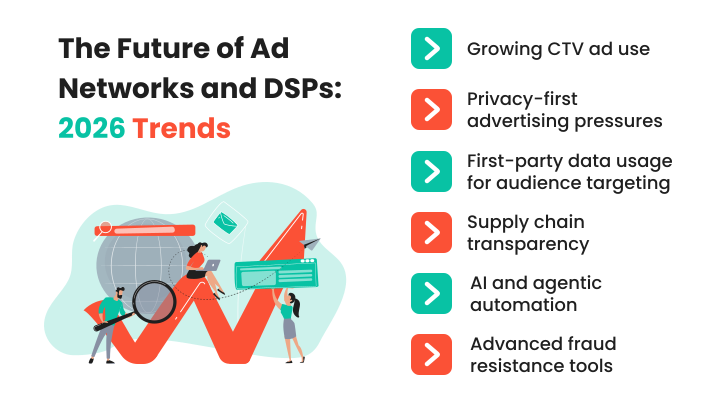
The Future of Ad Networks and DSPs: 2026 Trends

Structural shifts in identity, supply chain transparency, and AI-driven automation are reshaping how both ad networks and DSPs operate.

The core trends experts recommend watching out for include:

Learn The Future of Ad Networks and DSPs_ 2026 Trends
  • Growing CTV ad use. Advertising on CTV is no longer optional; this channel is expected to show the highest growth tempo in 2026 and beyond. Advertisers are responding to this trend by inventing new CTV ad formats and updating CTV advertising guidelines to build a competitive presence.
  • Privacy-first advertising pressures. Google’s Privacy Sandbox guidance helps advertisers stay resilient in the post-cookie space. While cookies still exist, their use becomes more challenging and legally risky. Thus, DSPs and ad networks are revising their strategies towards contextual targeting, clean-room workflows, and first-party data. User content gains prominence in this new space, and privacy-safe packaged ad sales are rising in demand.
  • First-party data usage for audience targeting. Cookies don’t work as they used to, so brands shift their focus to privacy-centric audience strategies. Accurate and efficient ad targeting is attainable via partnerships with retail media networks and clean-room data providers. Commerce-driven advertising based on closed-loop, internal measurements is also a promising path. DSPs and ad networks respond to these changes by delivering audience exclusion data, lookalike analytics, and cross-channel sequencing services.
  • Supply chain transparency. The programmatic advertising market is moving towards transparency and standardization, with more advertisers looking for explicit and visible supply paths. AdTech operators respond to this trend by investing in seller and fee transparency, supply path optimization, and the provision of curated private marketplaces with high-quality inventory access.
  • AI and agentic automation. Rising AI adoption is a major disruptor of the traditional AdTech space. For instance, the Agentic RTB Framework (ARTF) released by IAB Tech Lab is an excellent example of the RTB rule-changer, with programmatic workflows dynamically fine-tuned with agentic AI. In this respect, DSPs are gaining a competitive advantage over ad networks because they harness AI for improved bid valuation, decision speed, and audience enrichment. Ad networks also adopt AI, but it mostly operates on the network side, thus remaining a black box for users.
  • Advanced fraud resistance tools. Media quality, transparency, and operational consistency still represent the main risks and barriers in the AdTech industry. Thus, operators are pressured to develop effective anti-fraud measures and transparency tools to keep clients’ trust. Viable paths for improving these parameters include combined verification signals, advanced supply and quality filters, and continuous ad buying decision adjustment based on the fraud and quality analysis outcomes.
Evaluating whether to rely on packaged inventory or build direct buying control?

Our AdTech consultants can help you assess cost structures, targeting models, and infrastructure trade-offs before you commit.

Conclusion

Choosing between an ad network vs DSP is ultimately a question of control, transparency, and operational complexity.

Ad networks provide simplified access to inventory and faster activation, making them suitable for advertisers prioritizing ease of execution. DSPs offer impression-level control, deeper visibility, and advanced optimization capabilities, making them better suited for teams seeking scalable performance and granular targeting.

As programmatic advertising evolves toward greater transparency and privacy compliance, the right choice depends on how much control and responsibility your organization is ready to assume.

Is pricing the best criterion for ad network vs. DSP selection?

The costs of using ad networks are usually lower, but the price of cost-efficiency is the transparency tradeoff. Brands often lose control over ad inventory selection and don’t understand how much they pay for ads and how much goes to the network by choosing packaged pricing.

What benefits do DSPs offer to brands?

The main benefit of DSPs is accurate audience targeting and optimized RTB decision-making. Brands using DSPs have greater control over targeting and can use advanced brand safety and fraud prevention tools to protect their ad budgets.

What is the future for ad networks and DSPs?

Competition in the CTV ad space becomes more pronounced, and privacy-first advertising rules are introducing profound changes to AdTech operating models. The future of advertising relies on first-party data and supply chain transparency, which guarantee client trust and build credibility in the programmatic ad buying space.

Recommended Reading

Let Us Contact You

Fill out the form below and we’ll get in touch within 24 hours

    contact us2
    Software development expertise and senior tech talent for AdTech and Streaming Media projects.